


- Home
- A-Z Catalogue
- Products
- Valves
- Cetop
- Manual Directional Valves
- Proportional Valves
- Poppet Valves
- High-Speed Linear Servo Valves
- All High-Speed Linear Servo Valves
- Cetop 10 (NG32) Two Stage Type High Speed Linear Servo Valves – LSVHG-10
- Cetop 10 (NG32) Two Stage Type High Speed Linear Servo Valves – LSVHG-10 (With Fail-Safe)
- Cetop 8 (NG25) Two Stage Type High Speed Linear Servo Valves – LSVHG-06
- Cetop 8 (NG25) Two Stage Type High Speed Linear Servo Valves – LSVHG-06 (With Fail-Safe)
- Cetop 7 (NG16) Two Stage Type High Speed Linear Servo Valves – LSVHG-04
- Cetop 7 (NG16) Two Stage Type High Speed Linear Servo Valves – LSVHG-04 (With Fail-Safe)
- Cetop 5 (NG10) Direct Type High Speed Linear Servo Valves – LSVG-03
- Cetop 5 (NG10) OBE Type Direct Operated Linear Servo Valves – LSVG-03-EH
- Cetop 3 (NG6) OBE Type Direct Operated Linear Servo Valves – LSVG-01-EH
- Pumps
- Pressure control
- Flow Control Valves
- Pressure Control Valves
- All Pressure Control Valves
- Brake Valves
- Direct Relief Valve
- Low Noise Solenoid Controlled Relief Valves
- Low Noise Pilot Operated Relief Valves
- Pilot Operated Relief Valves
- Pressure reducing and relieving valves
- Pressure reducing and check valves
- Pressure control valves
- Remote Control Relief Valves
- Solenoid Controlled Relief Valves – BSG
- Solenoid Controlled Relief Valves – BST
- Unloading relief valves
- Check valves
- Environmental
- Valves
- Hydraulic Systems
- Power pack
- About Us
- Contact
- Blog

2026 Top Quick Connect Fitting Types for Global Buyers?
Global buyers entering 2026 will evaluate Quick Connect Fitting types through performance, compatibility, and lifecycle cost. MarketsandMarkets’ industrial couplings research identifies growing demand for faster maintenance, modular equipment, and reduced fluid leakage. Grand View Research also links industrial component growth with automation, process efficiency, and expanding manufacturing capacity. These signals matter. A fitting is small, but a poor connection can stop an entire production line.
This guide examines hydraulic, pneumatic, cam-and-groove, dry-break, threaded, and food-grade Quick Connect Fitting designs. Each type serves a different operating reality. A hydraulic coupling may face high pressure and vibration. A pneumatic fitting may prioritize rapid tool changes. A dry-break model may protect sensitive fluids during hose separation. Buyers should verify working pressure, temperature range, media compatibility, sealing material, flow rate, and connection size before comparing prices. ISO 7241 and related international standards provide useful reference points, but certification needs careful checking.
Real-world selection is less tidy than product catalogs suggest. Corrosion, dust, uneven installation, and operator habits can change results. Sometimes the cheapest fitting becomes the costliest choice. That assumption deserves review. Reports from Mordor Intelligence and Fortune Business Insights indicate continued investment in industrial automation and fluid-handling systems, yet regional specifications and supply reliability still vary. Global buyers should request traceable test data, dimensional drawings, sample inspections, and replacement-part availability. The best 2026 choice will not simply connect quickly. It will remain secure, serviceable, and predictable under actual working conditions.
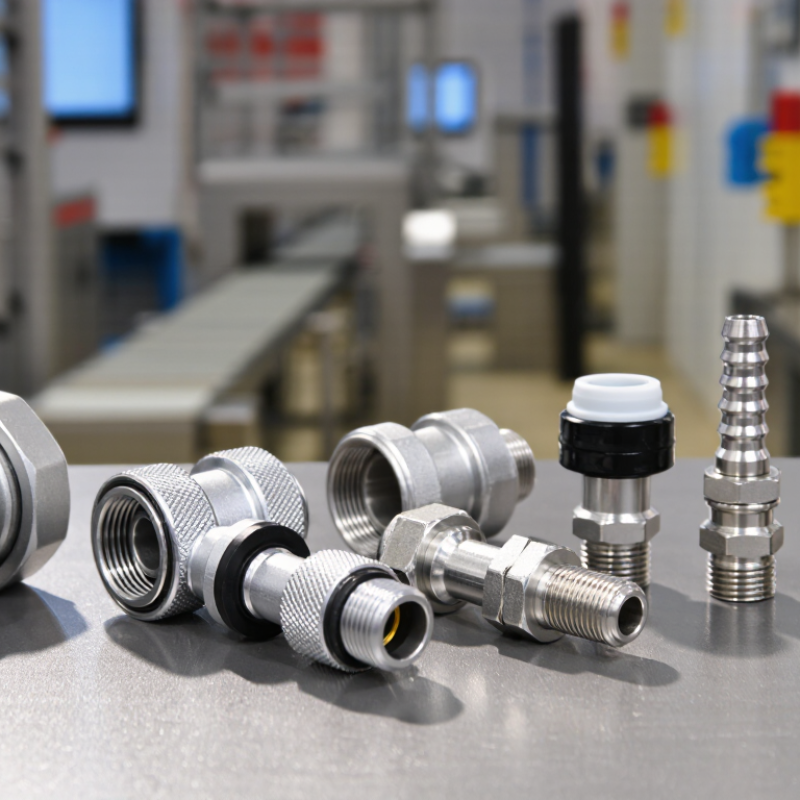
Table of Contents [Hide]
Quick Connect Fittings: Definition, Structure, and Operating Principles
Quick connect fittings link fluid or air lines without wrenches. Their structure is simple, but precision matters. A plug enters a socket, while locking balls, a sleeve, and springs hold the connection. Internal poppet or ball valves open when both halves engage. They close automatically after separation, limiting fluid loss and contamination.
Common types include poppet, ball-lock, and flat-face designs. Poppet couplings suit general hydraulic and pneumatic service. Ball-lock models offer fast manual connection. Flat-face fittings reduce trapped air and surface leakage, making them useful in mobile equipment. Grand View Research valued the global industrial valves market at approximately USD 78 billion in 2023, showing the scale of the valve systems surrounding these smaller components. The report also projects steady growth through 2030.
Operating pressure, temperature, media, and connection frequency determine the correct type. A stainless-steel body may resist corrosion, while an elastomer seal controls leakage around the plug. ISO 4414 principles also stress safe pneumatic design and controlled energy release. Practical inspection remains essential. Check sleeve movement, seal damage, and visible contamination before coupling. Small particles can scratch sealing surfaces. I have seen fittings fail early because users focused on thread size alone. That was an incomplete judgment. MarketsandMarkets identifies rising automation as a major driver for fluid-control components, yet published market figures vary by product definition. Buyers should verify test standards, flow ratings, and cycle-life data before comparing suppliers.