


- Home
- A-Z Catalogue
- Products
- Valves
- Cetop
- Manual Directional Valves
- Proportional Valves
- Poppet Valves
- High-Speed Linear Servo Valves
- All High-Speed Linear Servo Valves
- Cetop 10 (NG32) Two Stage Type High Speed Linear Servo Valves – LSVHG-10
- Cetop 10 (NG32) Two Stage Type High Speed Linear Servo Valves – LSVHG-10 (With Fail-Safe)
- Cetop 8 (NG25) Two Stage Type High Speed Linear Servo Valves – LSVHG-06
- Cetop 8 (NG25) Two Stage Type High Speed Linear Servo Valves – LSVHG-06 (With Fail-Safe)
- Cetop 7 (NG16) Two Stage Type High Speed Linear Servo Valves – LSVHG-04
- Cetop 7 (NG16) Two Stage Type High Speed Linear Servo Valves – LSVHG-04 (With Fail-Safe)
- Cetop 5 (NG10) Direct Type High Speed Linear Servo Valves – LSVG-03
- Cetop 5 (NG10) OBE Type Direct Operated Linear Servo Valves – LSVG-03-EH
- Cetop 3 (NG6) OBE Type Direct Operated Linear Servo Valves – LSVG-01-EH
- Pumps
- Pressure control
- Flow Control Valves
- Pressure Control Valves
- All Pressure Control Valves
- Brake Valves
- Direct Relief Valve
- Low Noise Solenoid Controlled Relief Valves
- Low Noise Pilot Operated Relief Valves
- Pilot Operated Relief Valves
- Pressure reducing and relieving valves
- Pressure reducing and check valves
- Pressure control valves
- Remote Control Relief Valves
- Solenoid Controlled Relief Valves – BSG
- Solenoid Controlled Relief Valves – BST
- Unloading relief valves
- Check valves
- Environmental
- Valves
- Hydraulic Systems
- Power pack
- About Us
- Contact
- Blog

2026 Top Solar Panel Gasket Types for Global Buyers
As solar projects expand across rooftops, farms, and coastal installations, gasket selection deserves more attention. In 2026, global buyers must evaluate more than price and availability. A Solar Panel Gasket helps seal module frames, junction areas, and mounting interfaces against water, dust, vibration, and thermal movement. Small sealing failures can create large maintenance costs.
This guide introduces the leading gasket types used in modern photovoltaic systems. It compares EPDM, silicone, neoprene, rubber foam, and custom molded profiles. Each material behaves differently under ultraviolet exposure, temperature changes, compression, and humidity. EPDM often suits outdoor environments because of its weather resistance. Silicone remains valuable where wide temperature performance matters. However, neither material is automatically the best choice. Local climate decides much of the result.
Look closely at details. A gasket may appear secure but lose pressure after repeated heating and cooling. A profile may fit one frame perfectly yet deform on another. Buyers should review hardness, compression set, dimensional tolerance, adhesive compatibility, and service temperature. Product drawings and test reports provide stronger evidence than marketing claims. Supplier experience also matters, especially for projects crossing multiple climates and manufacturing standards. Ask for samples.
There is no universal winner. Some decisions remain uncertain until real installation conditions are tested. Reliable procurement combines laboratory data, field experience, traceable materials, and clear quality controls. This overview supports a practical comparison, but engineers should confirm every selection with the module manufacturer and project specifications. Small components still deserve serious engineering.
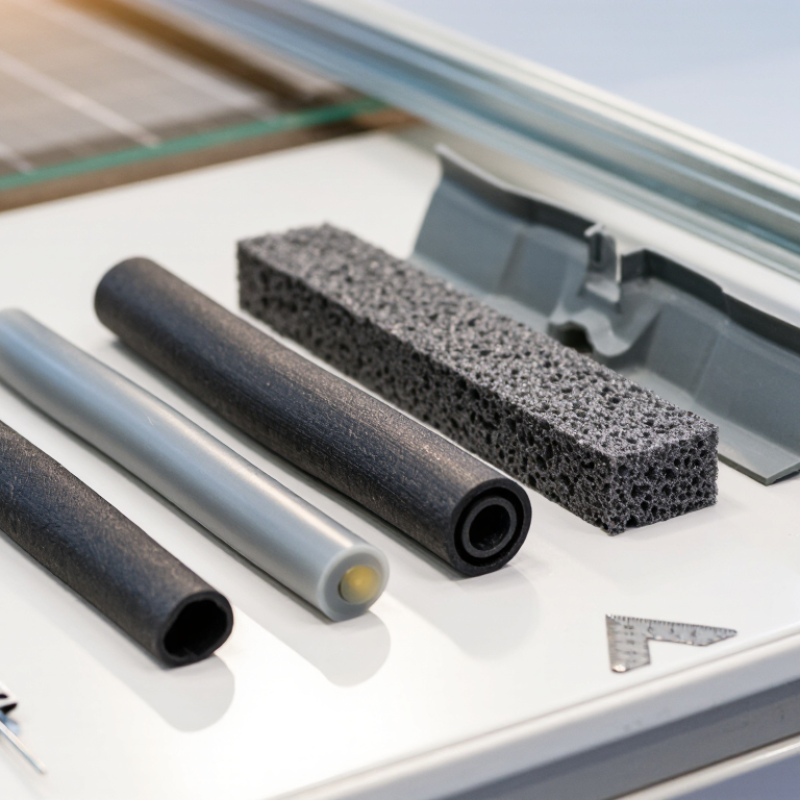
Table of Contents [Hide]
What Solar Panel Gaskets Are and Why They Matter
What Solar Panel Gaskets Are and Why They Matter
A solar panel gasket is a flexible sealing component placed between the module frame, glass, junction box, or cable entry. It closes narrow gaps where water, dust, and air could enter. Common gasket materials include silicone, EPDM, and butyl rubber. Each behaves differently under ultraviolet exposure, heat, compression, and repeated expansion.
The need is growing quickly. The IEA PVPS Trends in Photovoltaic Applications 2024 report recorded approximately 456 GW of new photovoltaic capacity in 2023. Cumulative global capacity exceeded 1.6 TW. Every module represents another sealing surface exposed to weather. A small edge gap can collect moisture after rain. Later, thermal expansion may widen it.
Good gasket selection depends on the installation environment. Silicone usually offers strong weather resistance and stable flexibility. EPDM performs well against ozone and outdoor aging. Butyl materials can provide effective moisture barriers, but their long-term behavior needs careful testing.
Buyers should review compression set, tensile strength, water absorption, and temperature limits. IEC 61215 and IEC 61730 testing also support module safety and durability evaluations.
A gasket is not glamorous. That may be the point. It should maintain contact without excessive pressure on the glass or frame. Yet specifications can mislead when laboratory conditions differ from rooftops. The NREL PV Lifetime Project has documented how heat, moisture, ultraviolet radiation, and mechanical stress influence photovoltaic reliability. Ask for test evidence, production tolerances, and field experience, not only a material name.