


- Home
- A-Z Catalogue
- Products
- Valves
- Cetop
- Manual Directional Valves
- Proportional Valves
- Poppet Valves
- High-Speed Linear Servo Valves
- All High-Speed Linear Servo Valves
- Cetop 10 (NG32) Two Stage Type High Speed Linear Servo Valves – LSVHG-10
- Cetop 10 (NG32) Two Stage Type High Speed Linear Servo Valves – LSVHG-10 (With Fail-Safe)
- Cetop 8 (NG25) Two Stage Type High Speed Linear Servo Valves – LSVHG-06
- Cetop 8 (NG25) Two Stage Type High Speed Linear Servo Valves – LSVHG-06 (With Fail-Safe)
- Cetop 7 (NG16) Two Stage Type High Speed Linear Servo Valves – LSVHG-04
- Cetop 7 (NG16) Two Stage Type High Speed Linear Servo Valves – LSVHG-04 (With Fail-Safe)
- Cetop 5 (NG10) Direct Type High Speed Linear Servo Valves – LSVG-03
- Cetop 5 (NG10) OBE Type Direct Operated Linear Servo Valves – LSVG-03-EH
- Cetop 3 (NG6) OBE Type Direct Operated Linear Servo Valves – LSVG-01-EH
- Pumps
- Pressure control
- Flow Control Valves
- Pressure Control Valves
- All Pressure Control Valves
- Brake Valves
- Direct Relief Valve
- Low Noise Solenoid Controlled Relief Valves
- Low Noise Pilot Operated Relief Valves
- Pilot Operated Relief Valves
- Pressure reducing and relieving valves
- Pressure reducing and check valves
- Pressure control valves
- Remote Control Relief Valves
- Solenoid Controlled Relief Valves – BSG
- Solenoid Controlled Relief Valves – BST
- Unloading relief valves
- Check valves
- Environmental
- Valves
- Hydraulic Systems
- Power pack
- About Us
- Contact
- Blog

Why Choose a 3 Phase Socket for Global Power Needs?
Choosing the right 3 Phase Socket can determine whether global equipment operates safely, efficiently, and consistently. Factories, data centers, workshops, and construction sites often demand higher power than ordinary single-phase outlets can provide. A three-phase connection distributes electrical load more evenly, helping motors start smoothly and reducing stress on cables and equipment.
Electrical educator Mike Holt is widely known for the warning, “Electricity is not forgiving.” That principle matters when selecting a 3 Phase Socket for international applications. Voltage, frequency, current rating, phase sequence, grounding, and connector configuration must match the equipment and the installation site. A socket designed for 400 volts may not suit a 480-volt system. A familiar plug shape proves very little.
Small choices matter. So does the enclosure. Dusty workshops may require a higher IP rating, while outdoor installations need protection from rain, impact, and corrosion. Compliance with relevant IEC, BS, UL, or regional requirements also supports reliable sourcing and inspection. However, standards differ across markets, and no universal socket fits every application.
This is where practical experience becomes valuable. Engineers should review load calculations, cable sizing, thermal conditions, and emergency isolation before approving a connection. Qualified professionals must complete installation and testing. Mistakes can remain invisible until a motor overheats or production stops.
The decision is not only about power capacity. It is about compatibility, safety, maintenance, and future expansion. That sounds straightforward, but real sites rarely are. A carefully selected 3 Phase Socket can support global operations, although every project still deserves a fresh technical review.
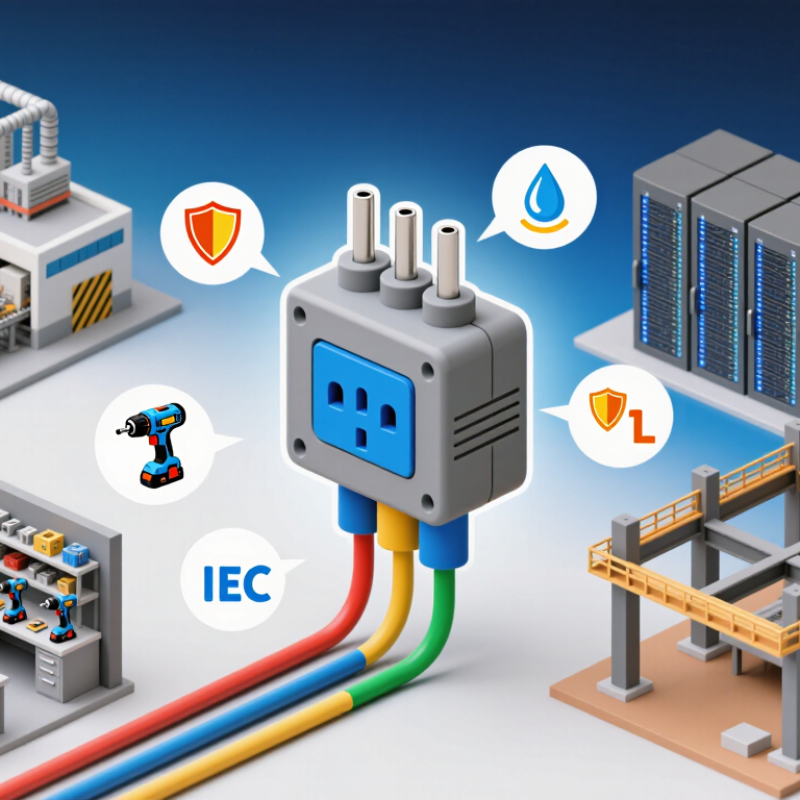
Table of Contents [Hide]
What Is a Three-Phase Socket and How Does It Work?
A three-phase socket delivers power through three alternating current conductors. Each phase reaches its peak at a different point in the cycle. This timing creates a smoother flow of electrical energy. It also supports motors that need a rotating magnetic field. In practical terms, a motor starts more steadily and runs with less vibration.
The socket usually includes phase contacts, protective earth, and sometimes a neutral contact. The exact arrangement depends on the voltage system and local electrical standard. A qualified electrician checks the pin layout, frequency, phase sequence, and grounding before connection. One mistake can reverse motor rotation. That matters for pumps, compressors, conveyors, and machine tools. It can also damage equipment if protection is missing.
In a workshop, the difference is easy to notice. A heavy motor sounds less strained under a balanced load. Cables may stay cooler as current divides across three phases. My first assumption was that any three-phase socket could serve any country. That was wrong. Socket geometry, voltage, frequency, and installation rules can vary widely. A compatible plug is not enough. The circuit also needs suitable breakers, cable sizing, enclosure protection, and tested earth continuity. Keep records. Even a simple label showing phase order can prevent confusion during maintenance.
Why Choose a 3 Phase Socket for Global Power Needs? - What Is a Three-Phase Socket and How Does It Work?
| Data Dimension | Three-Phase Socket Information | Why It Matters for Global Power Needs |
|---|---|---|
| Basic Definition | A three-phase socket is an electrical outlet designed to supply power through three alternating-current phases, commonly with protective earth and, where required, a neutral conductor. | It supports higher-power equipment and balanced electrical loads more efficiently than a typical single-phase outlet. |
| How the Three Phases Work | The three sinusoidal voltage waveforms are separated by approximately 120 electrical degrees. Each phase reaches its peak at a different time. | Power delivery is smoother, which is particularly useful for motors, compressors, pumps, HVAC systems, and industrial machinery. |
| Common Nominal Voltage Systems | Examples include 208Y/120 V, 400Y/230 V, and 480Y/277 V systems. Actual values depend on the country, utility network, and installation standard. | Checking both line-to-line and line-to-neutral voltage helps equipment operate safely across different electrical regions. |
| Operating Frequency | Three-phase systems commonly operate at 50 Hz or 60 Hz, depending on the local power grid and equipment requirements. | Motors, transformers, and control equipment must be rated for the local frequency to avoid overheating, speed errors, or malfunction. |
| Typical Socket Current Ratings | Common industrial ratings include 16 A, 32 A, 63 A, and 125 A. The correct rating depends on the connected load, cable size, protective device, and local code. | A suitable current rating prevents overheating and allows the socket, plug, cable, and circuit protection to work as a coordinated system. |
| Conductor Arrangements | Typical configurations are 3P+PE for three phases and protective earth, or 3P+N+PE when a neutral conductor is needed for line-to-neutral loads. | The conductor arrangement must match the equipment plug and the electrical distribution system; incorrect wiring can create serious hazards. |
| Power Calculation | For a balanced three-phase load: P = √3 × VLL × I × PF × η, where VLL is line-to-line voltage, I is current, PF is power factor, and η is efficiency when applicable. | The formula helps estimate usable power and select an appropriate socket, cable, breaker, and equipment capacity. |
| Example Apparent Power | A balanced 400 V three-phase circuit rated at 32 A provides approximately 22.2 kVA before power-factor and efficiency adjustments: √3 × 400 × 32 ÷ 1,000. | This illustrates why three-phase connections can deliver substantial power without requiring the same current on a single-phase circuit. |
| Common Applications | Industrial motors, machine tools, welders, air compressors, pumps, commercial kitchen equipment, data-center systems, and temporary power distribution. | These applications often require continuous, stable, and higher-capacity power than standard household outlets provide. |
| Load Balancing | Loads should be distributed as evenly as practical across the three phases, especially when both three-phase and single-phase equipment share the same supply. | Balanced loading can reduce neutral current, voltage imbalance, cable heating, and unnecessary stress on electrical equipment. |
| Motor Performance | A properly connected three-phase supply produces a rotating magnetic field in compatible motors, enabling efficient and smooth operation. | Three-phase motors generally have smooth torque characteristics and are well suited to demanding industrial duty. |
| Socket Protection Features | Depending on the installation, features may include keyed or clock-position coding, earth contacts, ingress protection, mechanical interlocking, and strain relief. | These features help prevent incorrect connections and improve protection against moisture, dust, accidental contact, and mechanical stress. |
| Ingress Protection | The required IP rating depends on the environment. Higher IP ratings provide greater resistance to dust and water entry when correctly installed. | Workshops, outdoor sites, food-processing areas, and washdown locations may require different environmental protection levels. |
| Installation Requirements | Installation requires compatible conductors, circuit protection, earthing, phase identification, fault-current consideration, and compliance with applicable electrical regulations. | Professional design and installation reduce the risk of electric shock, fire, equipment damage, and non-compliance. |
| Main Selection Checklist | Verify voltage, frequency, phase count, current rating, conductor arrangement, IP rating, plug/socket compatibility, cable size, protection, and local certification requirements. | A complete compatibility check is essential when equipment is moved between countries or connected to a different power distribution system. |
Safety note: Electrical ratings and wiring practices vary by country and installation type. Always confirm the supply characteristics and have three-phase equipment installed or inspected by a qualified electrician in accordance with applicable local regulations.