


- Home
- A-Z Catalogue
- Products
- Valves
- Cetop
- Manual Directional Valves
- Proportional Valves
- Poppet Valves
- High-Speed Linear Servo Valves
- All High-Speed Linear Servo Valves
- Cetop 10 (NG32) Two Stage Type High Speed Linear Servo Valves – LSVHG-10
- Cetop 10 (NG32) Two Stage Type High Speed Linear Servo Valves – LSVHG-10 (With Fail-Safe)
- Cetop 8 (NG25) Two Stage Type High Speed Linear Servo Valves – LSVHG-06
- Cetop 8 (NG25) Two Stage Type High Speed Linear Servo Valves – LSVHG-06 (With Fail-Safe)
- Cetop 7 (NG16) Two Stage Type High Speed Linear Servo Valves – LSVHG-04
- Cetop 7 (NG16) Two Stage Type High Speed Linear Servo Valves – LSVHG-04 (With Fail-Safe)
- Cetop 5 (NG10) Direct Type High Speed Linear Servo Valves – LSVG-03
- Cetop 5 (NG10) OBE Type Direct Operated Linear Servo Valves – LSVG-03-EH
- Cetop 3 (NG6) OBE Type Direct Operated Linear Servo Valves – LSVG-01-EH
- Pumps
- Pressure control
- Flow Control Valves
- Pressure Control Valves
- All Pressure Control Valves
- Brake Valves
- Direct Relief Valve
- Low Noise Solenoid Controlled Relief Valves
- Low Noise Pilot Operated Relief Valves
- Pilot Operated Relief Valves
- Pressure reducing and relieving valves
- Pressure reducing and check valves
- Pressure control valves
- Remote Control Relief Valves
- Solenoid Controlled Relief Valves – BSG
- Solenoid Controlled Relief Valves – BST
- Unloading relief valves
- Check valves
- Environmental
- Valves
- Hydraulic Systems
- Power pack
- About Us
- Contact
- Blog

7 Best Automated Forklifts for Warehouses in 2026
Warehouses are moving from fixed conveyor routes toward flexible, software-directed material handling. The Automated Forklift now operates between receiving docks, storage aisles, and packing stations with limited human intervention. Its sensors read pallet positions, aisle boundaries, and unexpected obstacles in real time.
The MHI 2024 Annual Industry Report found that 83% of supply-chain professionals expect greater robotics and automation adoption within five years. Interact Analysis also forecasts continued expansion in warehouse automation, driven by labor shortages, faster fulfillment, and rising operational complexity. The International Federation of Robotics reported strong growth in professional service robots for transportation and logistics. These figures support the market direction, but they do not guarantee immediate savings. Site layout, pallet quality, software integration, and worker training still decide practical performance.
Ash Sharma, Managing Director at Interact Analysis, has emphasized that automation succeeds when technology fits the workflow, rather than chasing novelty. That warning matters. An Automated Forklift may look impressive under showroom lighting, yet struggle with damaged pallets or narrow, crowded aisles. This guide examines seven leading systems for 2026, comparing navigation, payload capability, safety features, fleet software, charging options, and deployment support. Some rankings remain debatable. They should. Warehouse conditions differ sharply, and a costly machine is not automatically the best machine. The right choice should leave fewer idle minutes, safer pedestrian crossings, and clearer data on every pallet movement.
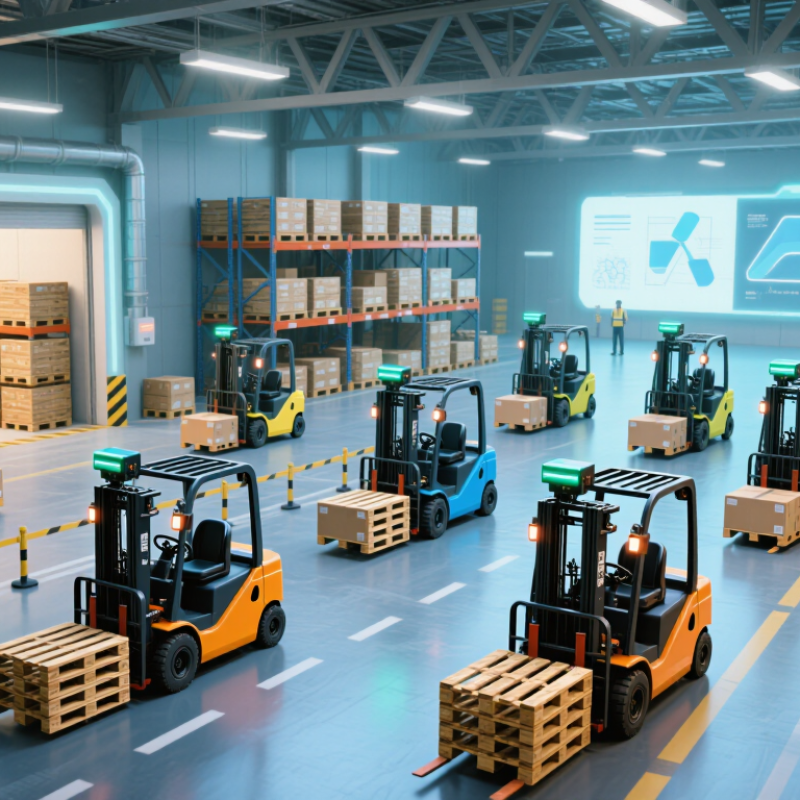
Table of Contents [Hide]
What Are Automated Forklifts and How Do They Work?
Automated forklifts are industrial vehicles that move, lift, and place pallets with limited human control. They follow digital routes instead of relying on a driver in the cab. In practical warehouse trials, they often handle repetitive transfers between storage aisles, packing zones, and loading docks. Their value is clearest during long shifts, when fatigue can affect driving accuracy.
These forklifts use cameras, laser scanners, sensors, and warehouse software to understand their surroundings. A control system compares the vehicle’s position with a stored map. It can identify racks, floor markings, people, and unexpected obstacles. Load sensors check whether a pallet is centered and within the rated capacity. At a receiving dock, the system may collect a pallet, confirm its location, and deliver it to an assigned slot. It slows near corners and stops when a person enters its path. That pause matters.
They are not flawless. A damaged barcode, dark floor surface, or misplaced pallet can interrupt a route. Software also depends on accurate inventory data and clearly defined traffic rules. Warehouse teams should test emergency stops, battery charging, pedestrian alerts, and manual handover procedures before full deployment. In my experience, the hardest part is often not navigation. It is changing daily habits. Workers may need time to trust a vehicle that moves quietly and makes decisions without visible instructions. Human supervision still matters, especially during unusual tasks, maintenance, and congested shifts.