


- Home
- A-Z Catalogue
- Products
- Valves
- Cetop
- Manual Directional Valves
- Proportional Valves
- Poppet Valves
- High-Speed Linear Servo Valves
- All High-Speed Linear Servo Valves
- Cetop 10 (NG32) Two Stage Type High Speed Linear Servo Valves – LSVHG-10
- Cetop 10 (NG32) Two Stage Type High Speed Linear Servo Valves – LSVHG-10 (With Fail-Safe)
- Cetop 8 (NG25) Two Stage Type High Speed Linear Servo Valves – LSVHG-06
- Cetop 8 (NG25) Two Stage Type High Speed Linear Servo Valves – LSVHG-06 (With Fail-Safe)
- Cetop 7 (NG16) Two Stage Type High Speed Linear Servo Valves – LSVHG-04
- Cetop 7 (NG16) Two Stage Type High Speed Linear Servo Valves – LSVHG-04 (With Fail-Safe)
- Cetop 5 (NG10) Direct Type High Speed Linear Servo Valves – LSVG-03
- Cetop 5 (NG10) OBE Type Direct Operated Linear Servo Valves – LSVG-03-EH
- Cetop 3 (NG6) OBE Type Direct Operated Linear Servo Valves – LSVG-01-EH
- Pumps
- Pressure control
- Flow Control Valves
- Pressure Control Valves
- All Pressure Control Valves
- Brake Valves
- Direct Relief Valve
- Low Noise Solenoid Controlled Relief Valves
- Low Noise Pilot Operated Relief Valves
- Pilot Operated Relief Valves
- Pressure reducing and relieving valves
- Pressure reducing and check valves
- Pressure control valves
- Remote Control Relief Valves
- Solenoid Controlled Relief Valves – BSG
- Solenoid Controlled Relief Valves – BST
- Unloading relief valves
- Check valves
- Environmental
- Valves
- Hydraulic Systems
- Power pack
- About Us
- Contact
- Blog

10 Best Car Battery Bus Bars for Global Buyers
The global transition toward electric mobility is increasing demand for safer, lighter, and more efficient power-distribution components. The International Energy Agency’s Global EV Outlook 2024 reported nearly 14 million electric car sales in 2023, while global battery demand for electric vehicles exceeded 750 GWh. These figures highlight a practical issue: battery performance depends on every connection, not only the cells.
A Car Battery Bus Bar links battery modules, fuses, disconnects, inverters, and other high-current equipment. It must manage heat, vibration, electrical resistance, and installation space inside a demanding vehicle environment. A small resistance increase can create unwanted heat. Poor plating may accelerate corrosion. Weak insulation can also increase maintenance risks. Standards such as ISO 6469 and IEC 61439 provide useful safety references, although product suitability still depends on the complete vehicle design.
This guide, “10 Best Car Battery Bus Bars for Global Buyers,” evaluates products through measurable and practical criteria. These include continuous current capacity, peak-current tolerance, conductor material, surface treatment, insulation quality, terminal design, dimensional accuracy, and supplier traceability. The review also considers customization support and documentation for international purchasing. Data from the U.S. Department of Energy and IEA underline the rapid scale of electrification, but market growth does not make every bus bar reliable.
Datasheets can look convincing.
Real-world performance may differ.
For that reason, buyers should verify temperature-rise testing, short-circuit ratings, mechanical strength, and relevant certifications before ordering. No ranking can replace system-level engineering. That is an important limitation. Still, a careful comparison can reduce selection errors and help global buyers identify bus bars suited to their voltage, current, packaging, and operating conditions.
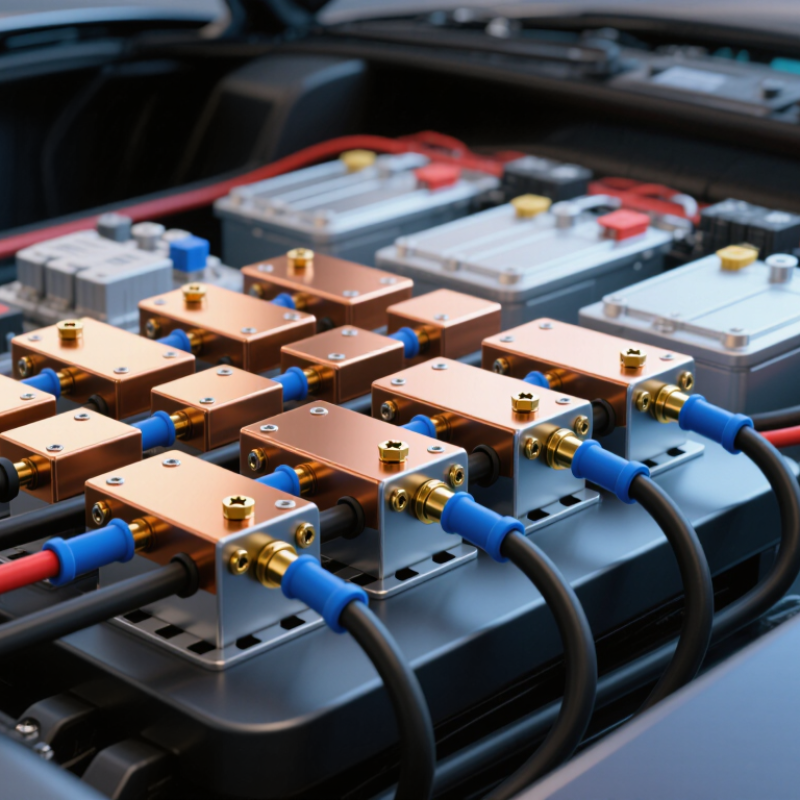
Table of Contents [Hide]
What Is a Car Battery Bus Bar and How Does It Work?
A car battery bus bar is a solid conductive strip that joins several electrical connections near the battery. It usually uses copper, tinned copper, or another low-resistance metal. Unlike a loose wire bundle, it creates one organized distribution point for power. It is not a fuse. It does not automatically stop excessive current.
The bus bar receives power from the battery through a properly sized cable. Bolted studs then send that power to circuits such as lighting, pumps, inverters, or auxiliary equipment. Each terminal should have a tight connection, a clean contact surface, and suitable insulation.
A protective cover matters because a dropped tool can create a dangerous short circuit. Measure twice. Confirm polarity carefully.
When comparing bus bars for global vehicle use, check continuous current capacity, peak load tolerance, stud size, mounting method, and resistance to vibration. Tinned surfaces can help in humid or salty environments, but they still need inspection.
A practical check includes looking for discoloration, loose nuts, melted insulation, or heat after normal operation. Do not choose only by advertised amperage; cable size and installation quality also control performance.
A common mistake is placing too many high-load circuits on one small bar. That approach may work briefly, then expose weak connections. Local electrical standards and vehicle instructions should guide the final installation.