


- Home
- A-Z Catalogue
- Products
- Valves
- Cetop
- Manual Directional Valves
- Proportional Valves
- Poppet Valves
- High-Speed Linear Servo Valves
- All High-Speed Linear Servo Valves
- Cetop 10 (NG32) Two Stage Type High Speed Linear Servo Valves – LSVHG-10
- Cetop 10 (NG32) Two Stage Type High Speed Linear Servo Valves – LSVHG-10 (With Fail-Safe)
- Cetop 8 (NG25) Two Stage Type High Speed Linear Servo Valves – LSVHG-06
- Cetop 8 (NG25) Two Stage Type High Speed Linear Servo Valves – LSVHG-06 (With Fail-Safe)
- Cetop 7 (NG16) Two Stage Type High Speed Linear Servo Valves – LSVHG-04
- Cetop 7 (NG16) Two Stage Type High Speed Linear Servo Valves – LSVHG-04 (With Fail-Safe)
- Cetop 5 (NG10) Direct Type High Speed Linear Servo Valves – LSVG-03
- Cetop 5 (NG10) OBE Type Direct Operated Linear Servo Valves – LSVG-03-EH
- Cetop 3 (NG6) OBE Type Direct Operated Linear Servo Valves – LSVG-01-EH
- Pumps
- Pressure control
- Flow Control Valves
- Pressure Control Valves
- All Pressure Control Valves
- Brake Valves
- Direct Relief Valve
- Low Noise Solenoid Controlled Relief Valves
- Low Noise Pilot Operated Relief Valves
- Pilot Operated Relief Valves
- Pressure reducing and relieving valves
- Pressure reducing and check valves
- Pressure control valves
- Remote Control Relief Valves
- Solenoid Controlled Relief Valves – BSG
- Solenoid Controlled Relief Valves – BST
- Unloading relief valves
- Check valves
- Environmental
- Valves
- Hydraulic Systems
- Power pack
- About Us
- Contact
- Blog

What Is the Best Industrial Touchscreen from China?
Choosing the best Industrial Touchscreen from China requires more than comparing prices, screen sizes, or factory photographs. A reliable panel must survive real production conditions: oil on gloves, water splashes, vibration, bright warehouse lighting, and continuous operation. The best choice depends on the application, not simply the supplier’s location.
Industry data supports this careful approach. MarketsandMarkets reports that the global industrial displays market is expanding as factories adopt automation, connected equipment, and human-machine interfaces. Grand View Research also identifies manufacturing and process industries as major users of rugged display technology. These trends explain why Chinese manufacturers now offer projected-capacitive, resistive, sunlight-readable, and embedded touchscreen systems for demanding environments. Yet market growth does not guarantee product quality.
Look closely.
A credible evaluation should examine IP ratings, operating temperature, touch response through gloves, brightness, connector protection, and long-term component availability. For example, a food-processing line may need a sealed IP65 front surface, while an outdoor control cabinet may require 1,000-nit brightness and thermal management. IEC 60529 provides the framework for IP protection claims, but certification documents still need verification.
Supplier experience matters. Ask for test records, burn-in procedures, sample units, and references from comparable installations. ISO 9001 certification can indicate controlled processes, although it cannot replace independent performance testing. Some manufacturers publish impressive specifications but provide limited evidence. That is an uncomfortable gap.
This guide compares Chinese Industrial Touchscreen suppliers through practical reliability, technical capability, customization, compliance, support, and total ownership cost. The “best” model may not be the cheapest one. It may be the panel that remains readable, responsive, and serviceable after thousands of operating hours.
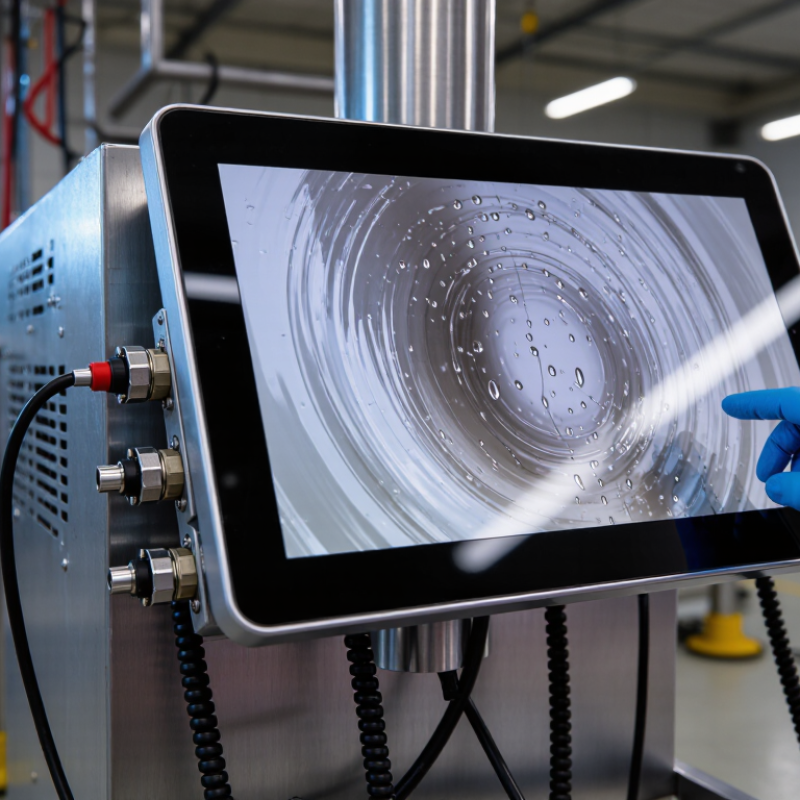
Table of Contents [Hide]
What Defines an Industrial Touchscreen?
Industrial touchscreen is not simply a larger tablet with a metal frame. It is a human-machine interface designed for dust, vibration, temperature changes, and repeated operation. In a factory, an operator may press the same control hundreds of times while wearing gloves. The panel must respond accurately, even when oil marks the surface.
A reliable industrial touchscreen usually combines projected capacitive, resistive, or infrared sensing with hardened cover glass. Projected capacitive technology offers smooth multi-touch control, but thick gloves can reduce sensitivity. Resistive technology often works better with gloves or a stylus, although it may feel less fluid. Engineers should check brightness, viewing angle, ingress protection, shock resistance, and operating temperature. A screen that looks impressive in a showroom may fail beside a hot cutting machine.
From practical testing, sunlight readability and connector placement deserve more attention than many buyers expect. A sealed enclosure helps, but poor cable routing can still invite moisture. I have also seen specifications hide an important weakness: touch accuracy near the edges. That detail needs testing, not assumption. The best unit matches the production environment, software, mounting method, and maintenance habits. China’s manufacturing strength can support customization, yet sample testing and documented quality controls remain essential. Some decisions remain imperfect. Cost savings may quietly reduce long-term reliability.