


- Home
- A-Z Catalogue
- Products
- Valves
- Cetop
- Manual Directional Valves
- Proportional Valves
- Poppet Valves
- High-Speed Linear Servo Valves
- All High-Speed Linear Servo Valves
- Cetop 10 (NG32) Two Stage Type High Speed Linear Servo Valves – LSVHG-10
- Cetop 10 (NG32) Two Stage Type High Speed Linear Servo Valves – LSVHG-10 (With Fail-Safe)
- Cetop 8 (NG25) Two Stage Type High Speed Linear Servo Valves – LSVHG-06
- Cetop 8 (NG25) Two Stage Type High Speed Linear Servo Valves – LSVHG-06 (With Fail-Safe)
- Cetop 7 (NG16) Two Stage Type High Speed Linear Servo Valves – LSVHG-04
- Cetop 7 (NG16) Two Stage Type High Speed Linear Servo Valves – LSVHG-04 (With Fail-Safe)
- Cetop 5 (NG10) Direct Type High Speed Linear Servo Valves – LSVG-03
- Cetop 5 (NG10) OBE Type Direct Operated Linear Servo Valves – LSVG-03-EH
- Cetop 3 (NG6) OBE Type Direct Operated Linear Servo Valves – LSVG-01-EH
- Pumps
- Pressure control
- Flow Control Valves
- Pressure Control Valves
- All Pressure Control Valves
- Brake Valves
- Direct Relief Valve
- Low Noise Solenoid Controlled Relief Valves
- Low Noise Pilot Operated Relief Valves
- Pilot Operated Relief Valves
- Pressure reducing and relieving valves
- Pressure reducing and check valves
- Pressure control valves
- Remote Control Relief Valves
- Solenoid Controlled Relief Valves – BSG
- Solenoid Controlled Relief Valves – BST
- Unloading relief valves
- Check valves
- Environmental
- Valves
- Hydraulic Systems
- Power pack
- About Us
- Contact
- Blog

How to Choose a Fully Electric Continuous Pyrolysis Plant?
Choosing a Fully Electric Continuous Pyrolysis Plant requires more than checking its heating power or advertised output. The decision should begin with feedstock reality. Moisture, particle size, ash content, and daily volume directly affect stability. A plant designed for dry wood may struggle with wet sludge or mixed agricultural residues.
Professor Robert C. Brown, a respected pyrolysis researcher, has emphasized this practical principle: “Pyrolysis performance depends strongly on heat transfer, residence time, and feedstock consistency.” That statement remains useful when comparing electric reactors. Buyers should examine heating uniformity, temperature-control accuracy, feeding reliability, and oxygen isolation. A stable reactor may hold a narrow temperature range around 450–600°C, depending on the selected material and process design. Small deviations can change char quality, gas composition, and oil yield.
The electrical system also deserves close attention. Request verified data for connected load, peak demand, insulation efficiency, and operating cost. Confirm whether the local grid can support continuous operation. Battery storage or renewable electricity may improve resilience, but they can increase investment. Ask for real operating records, not only laboratory results. Inspect the feed screw, seals, sensors, control cabinet, and emergency shutdown system. These details are easy to overlook.
A perfect plant does not exist. Some specifications may remain uncertain. That is where careful testing matters. Request a representative trial using your actual feedstock. Compare measured output with the supplier’s projections. A reliable Fully Electric Continuous Pyrolysis Plant should offer controllable performance, transparent maintenance requirements, and evidence that its design works beyond a sales demonstration.
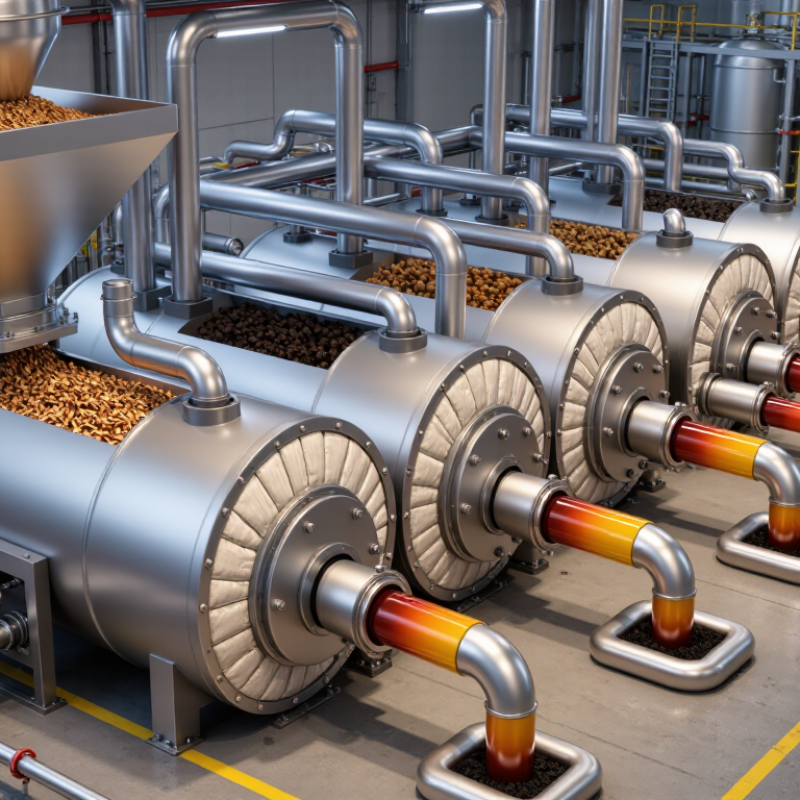
Table of Contents [Hide]
Core Design and Operating Principles of Fully Electric Continuous Pyrolysis Plants
Choosing a fully electric continuous pyrolysis plant starts with its heat-transfer design, not its nameplate capacity. The reactor should separate feeding, drying, pyrolysis, and char cooling into controlled zones. Electric resistance elements can deliver clean, adjustable heat around the reactor shell or through protected internal assemblies. Even heating matters. Cold pockets can leave unconverted feedstock, while hot spots may damage vapors or create unstable operation. A slow-speed screw or paddle system must maintain steady residence time. Feed rate, moisture, particle size, and bulk density directly affect that time.
During operation, sealed feeders limit air entry and protect the oxygen-limited environment. Temperature sensors should read several zones, not only the outlet. Pressure control, oxygen monitoring, and automatic shutdowns provide practical protection when feed conditions change. Vapors leave the reactor through heated lines, then pass through staged condensation or controlled gas handling. Non-condensable gas may support process heating after cleaning and stable pressure control. Char needs cooling before discharge. Otherwise, it can reheat in contact with air. Small details matter.
When comparing plants, request heat-balance data, electrical-load curves, residence-time tests, and independent material analyses. Ask how the system behaves during a wet-feed upset or a brief power interruption. Backup controls and safe cooling procedures are more valuable than impressive output figures. Maintenance access should be visible, with replaceable seals, insulated terminals, and clear sensor calibration records.
One point deserves skepticism:
“fully electric” does not automatically mean low-impact operation.
Electricity source, insulation quality, and downtime determine real performance. Operators should trace each claim to a sensor, test, or maintenance record.