


- Home
- A-Z Catalogue
- Products
- Valves
- Cetop
- Manual Directional Valves
- Proportional Valves
- Poppet Valves
- High-Speed Linear Servo Valves
- All High-Speed Linear Servo Valves
- Cetop 10 (NG32) Two Stage Type High Speed Linear Servo Valves – LSVHG-10
- Cetop 10 (NG32) Two Stage Type High Speed Linear Servo Valves – LSVHG-10 (With Fail-Safe)
- Cetop 8 (NG25) Two Stage Type High Speed Linear Servo Valves – LSVHG-06
- Cetop 8 (NG25) Two Stage Type High Speed Linear Servo Valves – LSVHG-06 (With Fail-Safe)
- Cetop 7 (NG16) Two Stage Type High Speed Linear Servo Valves – LSVHG-04
- Cetop 7 (NG16) Two Stage Type High Speed Linear Servo Valves – LSVHG-04 (With Fail-Safe)
- Cetop 5 (NG10) Direct Type High Speed Linear Servo Valves – LSVG-03
- Cetop 5 (NG10) OBE Type Direct Operated Linear Servo Valves – LSVG-03-EH
- Cetop 3 (NG6) OBE Type Direct Operated Linear Servo Valves – LSVG-01-EH
- Pumps
- Pressure control
- Flow Control Valves
- Pressure Control Valves
- All Pressure Control Valves
- Brake Valves
- Direct Relief Valve
- Low Noise Solenoid Controlled Relief Valves
- Low Noise Pilot Operated Relief Valves
- Pilot Operated Relief Valves
- Pressure reducing and relieving valves
- Pressure reducing and check valves
- Pressure control valves
- Remote Control Relief Valves
- Solenoid Controlled Relief Valves – BSG
- Solenoid Controlled Relief Valves – BST
- Unloading relief valves
- Check valves
- Environmental
- Valves
- Hydraulic Systems
- Power pack
- About Us
- Contact
- Blog

How to Choose a Surface Stress Meter for Global Sourcing?
Global sourcing changes the meaning of a good measurement decision. A surface stress meter must work accurately across suppliers, glass types, temperatures, and production environments. The right instrument supports safer purchasing, stronger quality control, and clearer technical communication. The wrong choice can create expensive disputes.
Dr. Arun K. Varshneya, a respected glass-science expert, has emphasized a practical principle: “Reliable glass performance begins with reliable understanding of its structure.” This idea applies directly to surface stress measurement. Buyers should examine optical range, measurement depth, repeatability, calibration procedures, and software compatibility. They should also verify whether the instrument suits chemically strengthened glass, tempered glass, or both.
Details matter.
A supplier may provide an impressive accuracy figure, yet offer weak calibration support. Another may sell a compact device that struggles beside a hot production line. Ask for test reports using samples similar to your products. Request evidence from laboratories, processors, or manufacturers with comparable conditions. Check how operators clean the prism, position the sample, and confirm readings.
Do not overlook training. A technically advanced surface stress meter can still produce unreliable results when users misunderstand edge effects or sample preparation. I have seen purchasing teams focus heavily on the initial price. They later face service delays, inconsistent readings, or unavailable replacement parts. That experience deserves reflection.
Global sourcing requires more than comparing specifications. It requires checking traceability, documentation, warranty coverage, regional support, and long-term operating costs. This guide explores those factors carefully, while acknowledging one uncomfortable truth: no instrument removes every measurement uncertainty. Good decisions manage uncertainty openly.
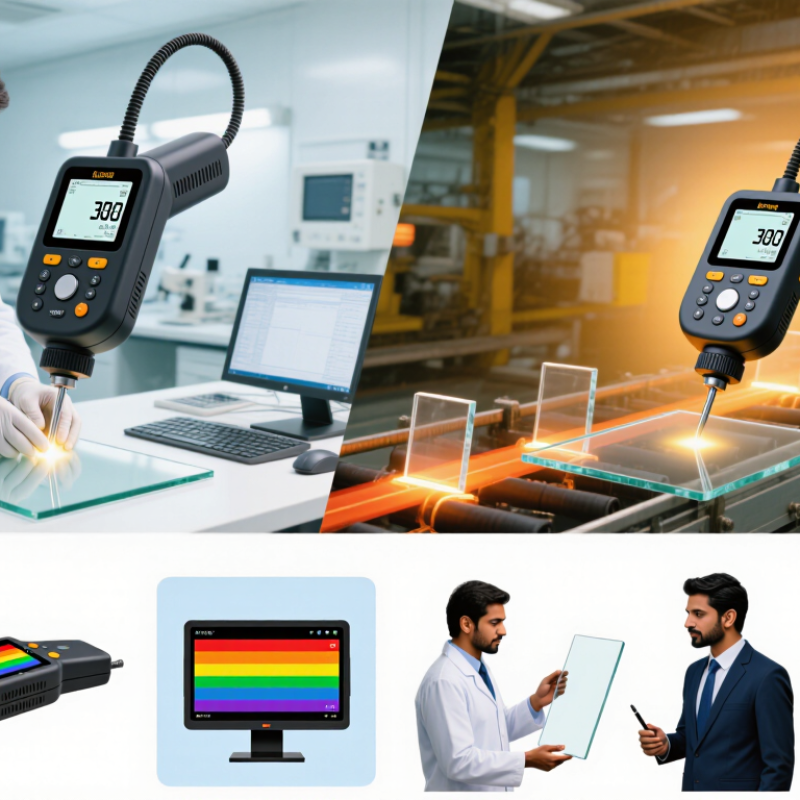
Table of Contents [Hide]
Surface Stress Meters: Purpose, Principles, and Measurement Methods
A surface stress meter reveals how tension and compression are distributed near a glass surface. Most instruments use photoelasticity. Polarized light passes through the glass, and stress changes its optical retardation. The meter converts that signal into surface stress and depth of layer. ASTM C1279 describes non-destructive photoelastic measurement for annealed, heat-strengthened, and fully tempered glass. ASTM C1422/C1422M also helps define requirements for chemically strengthened flat glass.
Measurement methods differ in speed, depth, and uncertainty. Optical photoelastic systems are fast for incoming inspection and production sampling. Scattered-light methods can examine stress below the surface, but they require careful alignment. Destructive chemical analysis may provide deeper profiles, yet it consumes the sample. NIST Technical Note 1297 recommends reporting expanded uncertainty, commonly with a coverage factor of k=2, close to 95% coverage. That number matters during global sourcing. A meter showing “high accuracy” without uncertainty data is not enough. I still recheck readings on curved or contaminated glass. Real factories are rarely perfect.
Tips: Ask for calibration records, stress range, depth capability, and repeatability data. Test the same reference sample across suppliers. Compare results under identical temperature and cleaning conditions. Keep the procedure short and documented. A useful meter should fit your material, not only your purchasing budget. Surface curvature, coating, thickness, and optical clarity can distort readings. Consider those details before comparing quotations.