


- Home
- A-Z Catalogue
- Products
- Valves
- Cetop
- Manual Directional Valves
- Proportional Valves
- Poppet Valves
- High-Speed Linear Servo Valves
- All High-Speed Linear Servo Valves
- Cetop 10 (NG32) Two Stage Type High Speed Linear Servo Valves – LSVHG-10
- Cetop 10 (NG32) Two Stage Type High Speed Linear Servo Valves – LSVHG-10 (With Fail-Safe)
- Cetop 8 (NG25) Two Stage Type High Speed Linear Servo Valves – LSVHG-06
- Cetop 8 (NG25) Two Stage Type High Speed Linear Servo Valves – LSVHG-06 (With Fail-Safe)
- Cetop 7 (NG16) Two Stage Type High Speed Linear Servo Valves – LSVHG-04
- Cetop 7 (NG16) Two Stage Type High Speed Linear Servo Valves – LSVHG-04 (With Fail-Safe)
- Cetop 5 (NG10) Direct Type High Speed Linear Servo Valves – LSVG-03
- Cetop 5 (NG10) OBE Type Direct Operated Linear Servo Valves – LSVG-03-EH
- Cetop 3 (NG6) OBE Type Direct Operated Linear Servo Valves – LSVG-01-EH
- Pumps
- Pressure control
- Flow Control Valves
- Pressure Control Valves
- All Pressure Control Valves
- Brake Valves
- Direct Relief Valve
- Low Noise Solenoid Controlled Relief Valves
- Low Noise Pilot Operated Relief Valves
- Pilot Operated Relief Valves
- Pressure reducing and relieving valves
- Pressure reducing and check valves
- Pressure control valves
- Remote Control Relief Valves
- Solenoid Controlled Relief Valves – BSG
- Solenoid Controlled Relief Valves – BST
- Unloading relief valves
- Check valves
- Environmental
- Valves
- Hydraulic Systems
- Power pack
- About Us
- Contact
- Blog

How to Choose the Right Heat-Resistant Castings for Your Needs?
Choosing the right Heat-Resistant Castings is crucial for various industries, from automotive to aerospace. According to a market report by MarketsandMarkets, the global demand for heat-resistant castings is expected to grow significantly, reaching over $21 billion by 2026. This growth shows a rising reliance on advanced materials that withstand high temperatures.
Heat-resistant castings must meet specific standards, often dictated by their application. The quality of these castings can influence performance and safety. A report by ResearchAndMarkets highlights that improper selection could lead to expensive failures and production downtimes, underscoring the importance of making an informed choice.
Many manufacturers face challenges when selecting heat-resistant materials. These include factors such as thermal fatigue, corrosion resistance, and manufacturing methods. Companies should conduct thorough research and evaluate their unique requirements before making a decision. Proper analysis can mitigate risks associated with material selection and enhance overall operational efficiency.
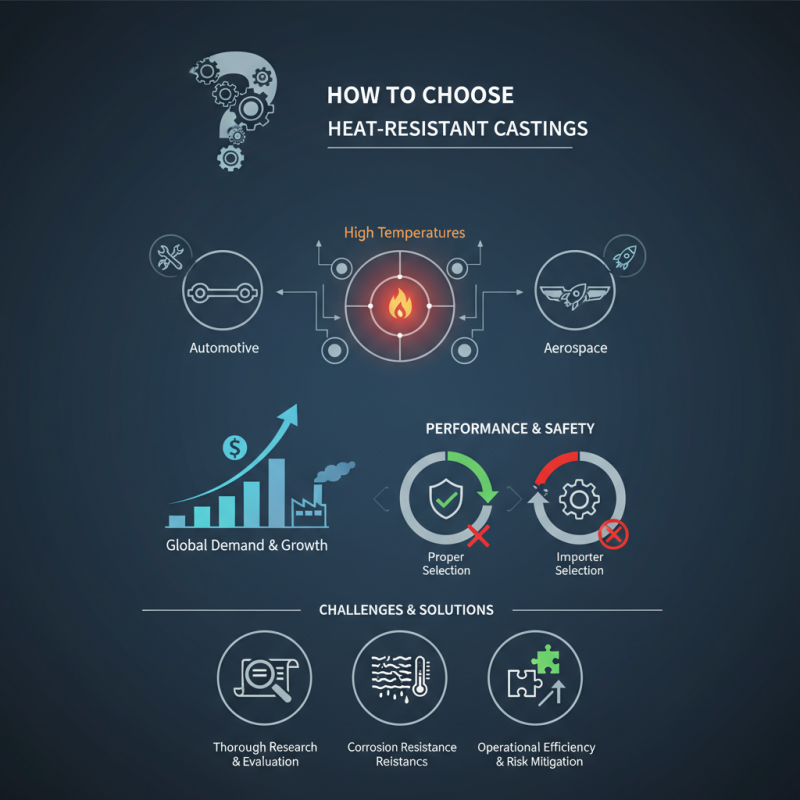
Table of Contents [Hide]
Understanding Heat-Resistant Castings and Their Applications
Heat-resistant castings are crucial in many industries that require durable components capable of withstanding extreme temperatures. These castings are made from materials that maintain structural integrity under high heat. Industries such as aerospace, automotive, and power generation heavily rely on them. According to a recent report by the International Casting Institute, the demand for heat-resistant castings is expected to grow by 5% annually through 2025.
Understanding the specific applications of heat-resistant castings can guide effective selection. For example, components used in gas turbines must endure temperatures exceeding 1,000 degrees Celsius. Such applications often employ nickel-based alloys, which are known for their high thermal resistance. A study published by the Metal Casting journal indicates that components manufactured with these materials demonstrate superior mechanical properties and fatigue resistance compared to conventional steel castings.
In contrast, some applications may not need extreme heat resistance but still require robustness. For example, foundry components in exhaust systems experience considerable thermal cycling but might not exceed 800 degrees Celsius. This calls for a careful balance between cost and performance, ensuring that manufacturers choose suitable materials without overspending. Selecting the correct type based on specific applications and thermal demands is essential for maximizing efficiency and longevity.