


- Home
- A-Z Catalogue
- Products
- Valves
- Cetop
- Manual Directional Valves
- Proportional Valves
- Poppet Valves
- High-Speed Linear Servo Valves
- All High-Speed Linear Servo Valves
- Cetop 10 (NG32) Two Stage Type High Speed Linear Servo Valves – LSVHG-10
- Cetop 10 (NG32) Two Stage Type High Speed Linear Servo Valves – LSVHG-10 (With Fail-Safe)
- Cetop 8 (NG25) Two Stage Type High Speed Linear Servo Valves – LSVHG-06
- Cetop 8 (NG25) Two Stage Type High Speed Linear Servo Valves – LSVHG-06 (With Fail-Safe)
- Cetop 7 (NG16) Two Stage Type High Speed Linear Servo Valves – LSVHG-04
- Cetop 7 (NG16) Two Stage Type High Speed Linear Servo Valves – LSVHG-04 (With Fail-Safe)
- Cetop 5 (NG10) Direct Type High Speed Linear Servo Valves – LSVG-03
- Cetop 5 (NG10) OBE Type Direct Operated Linear Servo Valves – LSVG-03-EH
- Cetop 3 (NG6) OBE Type Direct Operated Linear Servo Valves – LSVG-01-EH
- Pumps
- Pressure control
- Flow Control Valves
- Pressure Control Valves
- All Pressure Control Valves
- Brake Valves
- Direct Relief Valve
- Low Noise Solenoid Controlled Relief Valves
- Low Noise Pilot Operated Relief Valves
- Pilot Operated Relief Valves
- Pressure reducing and relieving valves
- Pressure reducing and check valves
- Pressure control valves
- Remote Control Relief Valves
- Solenoid Controlled Relief Valves – BSG
- Solenoid Controlled Relief Valves – BST
- Unloading relief valves
- Check valves
- Environmental
- Valves
- Hydraulic Systems
- Power pack
- About Us
- Contact
- Blog

How to Choose Stone Composite Floor for Global Buyers?
Choosing Stone Composite Floor for international projects requires more than comparing colors and factory prices. A sample may look identical under showroom lights, yet perform differently in a humid apartment or a busy retail entrance. Global buyers need to examine composition, thickness, wear-layer performance, dimensional stability, surface texture, and installation compatibility before approving a large order.
Practical purchasing experience shows that small details often create the largest costs. Check whether the core contains consistent mineral content and whether each carton has matching dimensions. Measure several planks from different boxes. Review moisture-resistance test results, abrasion ratings, fire-performance documents, and applicable regional certifications. Ask for production-batch traceability, packaging photographs, installation instructions, and a written warranty. A dependable supplier should explain limitations clearly, not promise that one product fits every climate.
There is no universal “best” Stone Composite Floor. Coastal warehouses, cold logistics centers, and luxury hotels demand different specifications. Even attractive digital samples can hide shade variation or uneven embossing. That matters. Buyers should request physical samples, independent test reports, and a pilot installation before final payment. A site review can reveal subfloor moisture, temperature changes, or acoustic concerns that product brochures overlook. Mistakes still happen, especially when specifications are translated poorly or local installers are unfamiliar with the locking system. Careful questions, documented checks, and honest supplier communication create a more reliable buying decision.
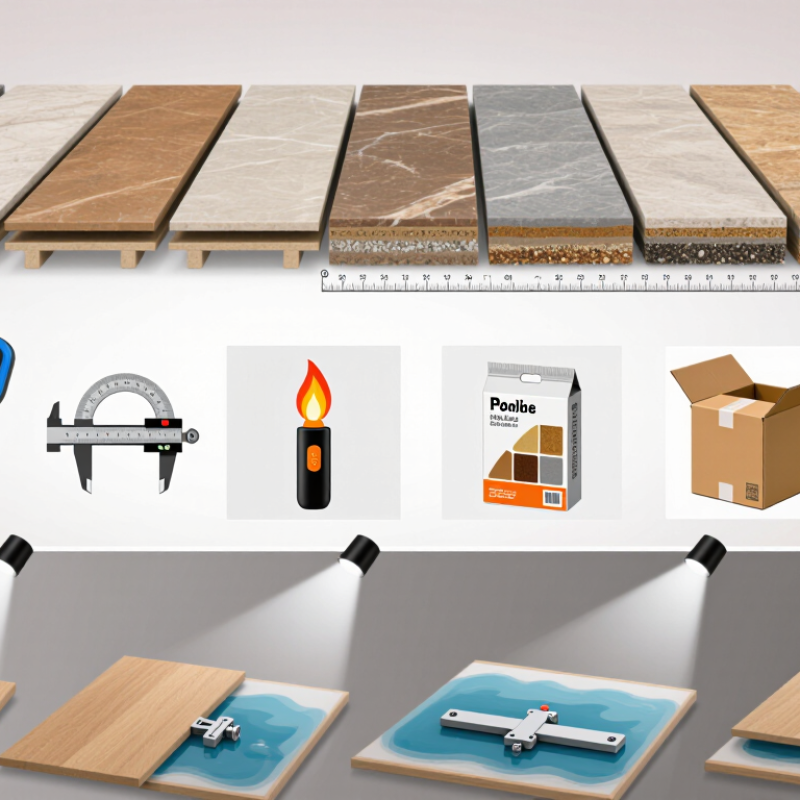
Table of Contents [Hide]
What Is Stone Composite Flooring and How Is It Made?
Stone composite flooring is a resilient floor covering with a mineral-rich core. It is often made from limestone powder, PVC resin, and carefully measured stabilizers. The mineral content adds rigidity. The polymer helps control moisture and impact.
Manufacturing starts by blending and heating these materials. The mixture passes through rollers or an extrusion line. It forms a dense, even core. Manufacturers then add a decorative film, wear layer, and protective surface coating. Click profiles are cut after cooling. Each stage affects the final result. Poor mixing may cause weak edges or uneven dimensions. A small flaw matters.
For global buyers, production details deserve close attention. Request test reports for dimensional stability, slip resistance, wear performance, fire behavior, and emissions. Requirements differ between countries and project types. Do not rely only on a product sample. Check several cartons for color variation, locking accuracy, and surface consistency. Measure the subfloor moisture before installation. Uneven concrete can create movement, even with a strong core. I would not treat a heavier board as automatic proof of quality. It may indicate more mineral content, but formulation and processing remain important. Leave the flooring in its installation environment when the technical instructions require acclimation. This step is easy to overlook.