


- Home
- A-Z Catalogue
- Products
- Valves
- Cetop
- Manual Directional Valves
- Proportional Valves
- Poppet Valves
- High-Speed Linear Servo Valves
- All High-Speed Linear Servo Valves
- Cetop 10 (NG32) Two Stage Type High Speed Linear Servo Valves – LSVHG-10
- Cetop 10 (NG32) Two Stage Type High Speed Linear Servo Valves – LSVHG-10 (With Fail-Safe)
- Cetop 8 (NG25) Two Stage Type High Speed Linear Servo Valves – LSVHG-06
- Cetop 8 (NG25) Two Stage Type High Speed Linear Servo Valves – LSVHG-06 (With Fail-Safe)
- Cetop 7 (NG16) Two Stage Type High Speed Linear Servo Valves – LSVHG-04
- Cetop 7 (NG16) Two Stage Type High Speed Linear Servo Valves – LSVHG-04 (With Fail-Safe)
- Cetop 5 (NG10) Direct Type High Speed Linear Servo Valves – LSVG-03
- Cetop 5 (NG10) OBE Type Direct Operated Linear Servo Valves – LSVG-03-EH
- Cetop 3 (NG6) OBE Type Direct Operated Linear Servo Valves – LSVG-01-EH
- Pumps
- Pressure control
- Flow Control Valves
- Pressure Control Valves
- All Pressure Control Valves
- Brake Valves
- Direct Relief Valve
- Low Noise Solenoid Controlled Relief Valves
- Low Noise Pilot Operated Relief Valves
- Pilot Operated Relief Valves
- Pressure reducing and relieving valves
- Pressure reducing and check valves
- Pressure control valves
- Remote Control Relief Valves
- Solenoid Controlled Relief Valves – BSG
- Solenoid Controlled Relief Valves – BST
- Unloading relief valves
- Check valves
- Environmental
- Valves
- Hydraulic Systems
- Power pack
- About Us
- Contact
- Blog

How to Choose a Temp And Humidity Monitor?
Choosing a Temp And Humidity Monitor is not merely a matter of comparing screen size or advertised accuracy. It is a decision about protecting products, people, equipment, and data quality. A sensor beside a cold window may show 18°C, while the storage shelf reads 23°C. Both readings can be correct in their locations.
The U.S. Environmental Protection Agency reports that people spend about 90% of their time indoors, making indoor conditions a practical health and productivity concern (EPA, Indoor Air Quality, 2024). ASHRAE Standard 55 also shows why temperature and humidity must be assessed together, rather than treated as separate numbers. P.O. Fanger, a leading thermal-comfort researcher, defined comfort as “that condition of mind which expresses satisfaction with the thermal environment.” His statement remains useful. Measurements should support human decisions, not create attractive dashboards.
A reliable Temp And Humidity Monitor should offer suitable accuracy, calibration records, data logging, visible alarms, and sensor placement guidance. ISO 7726 recommends careful measurement methods for thermal environments, especially when air movement and radiant heat affect results. Market reports from Grand View Research and MarketsandMarkets indicate continuing growth in environmental monitoring, driven by smart buildings, healthcare, logistics, and industrial compliance. Exact market forecasts vary. That is worth remembering.
The cheapest monitor may become expensive after one missed alarm. Wireless range can fail through concrete walls. Batteries can weaken quietly. Choosing well means matching the device to the room, the risk, and the people who will act on its readings. There is no perfect monitor. There is only a more defensible choice.
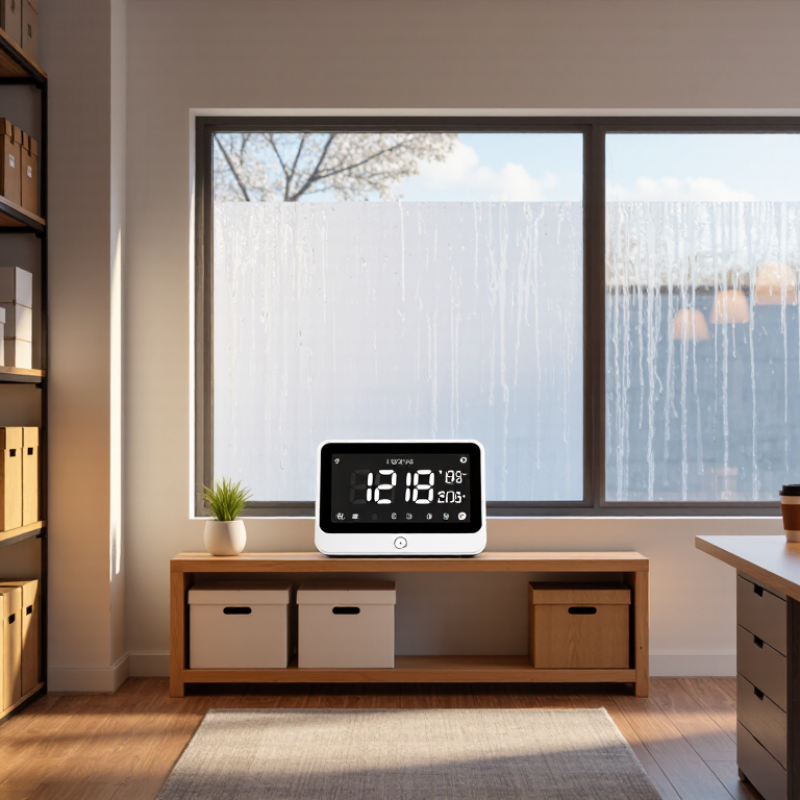
Table of Contents [Hide]
Define the Purpose and Environment for Monitoring Temperature and Humidity
Choosing a temperature and humidity monitor starts with defining the purpose. A bedroom, greenhouse, archive room, and laboratory need different measurements. Ask what decision the readings will support. You may need comfort data, equipment protection, product storage control, or evidence for an audit.
The environment matters just as much. A monitor near a window can record sunlight instead of room conditions. Steam, dust, airflow, and heat sources can also distort results. I once placed a sensor beside a ventilation outlet. The readings changed sharply whenever the fan started. That assumption was wrong. Consider the measurement range, response time, accuracy, and calibration requirements before choosing a device. For sensitive storage, regular calibration against a trusted reference is good practice. Keep records of dates, locations, and unusual events.
Tips: Map the room before installation. Mark windows, doors, vents, heaters, and damp corners. Place the sensor where people or materials are actually exposed. Avoid direct sunlight and hidden shelves. Test two locations for a day if conditions seem uneven. Check whether the monitor stores data during network interruptions. A visible alarm can help, but alarms need sensible limits. Setting them too tightly may create constant warnings. Setting them too loosely may hide gradual damage. Review the readings after several days, not just after installation. Small patterns often matter more than one dramatic number.





