


- Home
- A-Z Catalogue
- Products
- Valves
- Cetop
- Manual Directional Valves
- Proportional Valves
- Poppet Valves
- High-Speed Linear Servo Valves
- All High-Speed Linear Servo Valves
- Cetop 10 (NG32) Two Stage Type High Speed Linear Servo Valves – LSVHG-10
- Cetop 10 (NG32) Two Stage Type High Speed Linear Servo Valves – LSVHG-10 (With Fail-Safe)
- Cetop 8 (NG25) Two Stage Type High Speed Linear Servo Valves – LSVHG-06
- Cetop 8 (NG25) Two Stage Type High Speed Linear Servo Valves – LSVHG-06 (With Fail-Safe)
- Cetop 7 (NG16) Two Stage Type High Speed Linear Servo Valves – LSVHG-04
- Cetop 7 (NG16) Two Stage Type High Speed Linear Servo Valves – LSVHG-04 (With Fail-Safe)
- Cetop 5 (NG10) Direct Type High Speed Linear Servo Valves – LSVG-03
- Cetop 5 (NG10) OBE Type Direct Operated Linear Servo Valves – LSVG-03-EH
- Cetop 3 (NG6) OBE Type Direct Operated Linear Servo Valves – LSVG-01-EH
- Pumps
- Pressure control
- Flow Control Valves
- Pressure Control Valves
- All Pressure Control Valves
- Brake Valves
- Direct Relief Valve
- Low Noise Solenoid Controlled Relief Valves
- Low Noise Pilot Operated Relief Valves
- Pilot Operated Relief Valves
- Pressure reducing and relieving valves
- Pressure reducing and check valves
- Pressure control valves
- Remote Control Relief Valves
- Solenoid Controlled Relief Valves – BSG
- Solenoid Controlled Relief Valves – BST
- Unloading relief valves
- Check valves
- Environmental
- Valves
- Hydraulic Systems
- Power pack
- About Us
- Contact
- Blog

What Are Geosynthetic Materials and Their Main Types?
Geo Synthetic Materials are engineered polymers used to improve soil, water control, and structural performance. They appear beneath highways, around landfills, and beside drainage channels. Common types include geotextiles, geomembranes, geogrids, geocomposites, and geosynthetic clay liners. Each type performs a different function. Separation prevents soil mixing. Reinforcement distributes loads. Filtration allows water through while retaining particles.
The market is expanding, but the numbers require careful reading. Grand View Research estimated the global geosynthetics market at approximately USD 14.1 billion in 2023. Its report projects continued growth through 2030, driven by transport infrastructure, mining, and environmental protection. MarketsandMarkets has also identified infrastructure development and landfill applications as major demand areas. These figures describe commercial value, not guaranteed project success. Site conditions still decide performance.
Dr. Robert M. Koerner, a leading geosynthetics educator and founder of the Geosynthetic Institute, wrote, “Geosynthetics are synthetic materials used in geotechnical engineering.” That definition is simple, but not complete. Design quality depends on polymer selection, installation practices, drainage behavior, temperature, ultraviolet exposure, and long-term loading. A geomembrane may look flawless beside a containment pond, yet one poorly welded seam can undermine the entire system. This guide examines the main Geo Synthetic Materials, their practical roles, and the evidence behind their use. It also questions common assumptions. More material does not always mean better engineering. Performance must be measured against the site, the soil, and the intended service life.
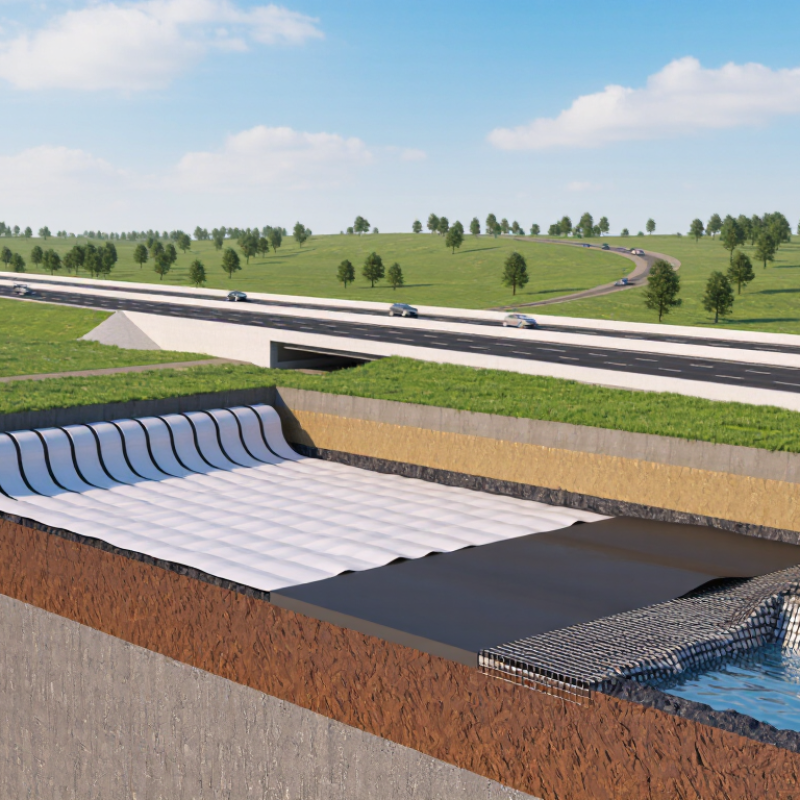
Table of Contents [Hide]
What Are Geosynthetic Materials and How Do They Work?
Geosynthetic materials are engineered products placed in soil or alongside it to improve ground performance. They are made from polymers, clay, or polymer-clay combinations. Their action depends on structure, loading, drainage, and installation quality. A geotextile may separate weak clay from crushed stone beneath a road. Its pores let water pass while holding soil particles apart. This reduces pumping, rutting, and the gradual mixing of layers. On real sites, a small overlap error can weaken an otherwise sound design.
Geogrids work differently. Their open, ribbed structure grips aggregate and spreads wheel loads across a wider area. This confinement can reduce deformation over soft subgrades. Geomembranes form low-permeability barriers around ponds, tunnels, and containment systems. They control liquid or vapor movement, but punctures, wrinkles, and poor seams can defeat that purpose. Geosynthetic clay liners add bentonite between carrier layers. When hydrated, the clay swells and creates a tight mineral barrier. Moisture conditions matter greatly.
Geocomposites combine functions, such as drainage and filtration, in one manufactured layer. A drainage core can carry water toward an outlet while protective fabrics prevent clogging. Geocells confine fill within three-dimensional pockets, helping stabilize slopes, channels, and access roads. Engineers select types after checking soil strength, water flow, chemical exposure, temperature, and expected loads. Installation deserves equal attention. Folded sheets, trapped stones, and untested seams create hidden risks. I have found that drawings often look precise, while field conditions remain stubbornly irregular. That gap requires inspection, testing, and sometimes a cautious redesign.