


- Home
- A-Z Catalogue
- Products
- Valves
- Cetop
- Manual Directional Valves
- Proportional Valves
- Poppet Valves
- High-Speed Linear Servo Valves
- All High-Speed Linear Servo Valves
- Cetop 10 (NG32) Two Stage Type High Speed Linear Servo Valves – LSVHG-10
- Cetop 10 (NG32) Two Stage Type High Speed Linear Servo Valves – LSVHG-10 (With Fail-Safe)
- Cetop 8 (NG25) Two Stage Type High Speed Linear Servo Valves – LSVHG-06
- Cetop 8 (NG25) Two Stage Type High Speed Linear Servo Valves – LSVHG-06 (With Fail-Safe)
- Cetop 7 (NG16) Two Stage Type High Speed Linear Servo Valves – LSVHG-04
- Cetop 7 (NG16) Two Stage Type High Speed Linear Servo Valves – LSVHG-04 (With Fail-Safe)
- Cetop 5 (NG10) Direct Type High Speed Linear Servo Valves – LSVG-03
- Cetop 5 (NG10) OBE Type Direct Operated Linear Servo Valves – LSVG-03-EH
- Cetop 3 (NG6) OBE Type Direct Operated Linear Servo Valves – LSVG-01-EH
- Pumps
- Pressure control
- Flow Control Valves
- Pressure Control Valves
- All Pressure Control Valves
- Brake Valves
- Direct Relief Valve
- Low Noise Solenoid Controlled Relief Valves
- Low Noise Pilot Operated Relief Valves
- Pilot Operated Relief Valves
- Pressure reducing and relieving valves
- Pressure reducing and check valves
- Pressure control valves
- Remote Control Relief Valves
- Solenoid Controlled Relief Valves – BSG
- Solenoid Controlled Relief Valves – BST
- Unloading relief valves
- Check valves
- Environmental
- Valves
- Hydraulic Systems
- Power pack
- About Us
- Contact
- Blog

How to Choose a Fire Resistant Fan?
Choosing a Fire-Resistant Fan requires more than checking a product label. In a hot, smoky room, airflow may determine whether people can escape safely. The right unit must match the building’s hazard, temperature, pressure, and ventilation design. A warehouse fan faces different demands from a kitchen exhaust fan. Experience matters here. I have seen specifications look impressive while the actual duty point was overlooked. That mistake can cause weak extraction, excessive noise, or premature failure. A careful selection begins with the application, not the catalogue photograph.
Reliable decisions use tested performance data and recognized certification. Check operating temperature, fire exposure duration, airflow, static pressure, motor placement, and electrical protection. Do not treat “fire-rated” as a universal promise. It may describe one component, not the complete installed system. Ask for test reports, installation limits, maintenance instructions, and traceable manufacturer information. An independent fire engineer or ventilation specialist should review critical applications. Local codes and project approvals also matter. Details matter.
During evaluation, imagine the fan above a stairwell, with hot air rising and access becoming difficult. Can it maintain its rated performance? Can technicians inspect belts, bearings, wiring, and dampers without unsafe delays? Consider standby power, control signals, corrosion, and emergency testing. A robust Fire-Resistant Fan still needs correct ductwork, secure mounting, and scheduled maintenance. Selection is not perfect science. Data can be incomplete, and site conditions may change. Record assumptions clearly, challenge optimistic claims, and confirm every critical value before installation. Safety deserves evidence, not guesswork.
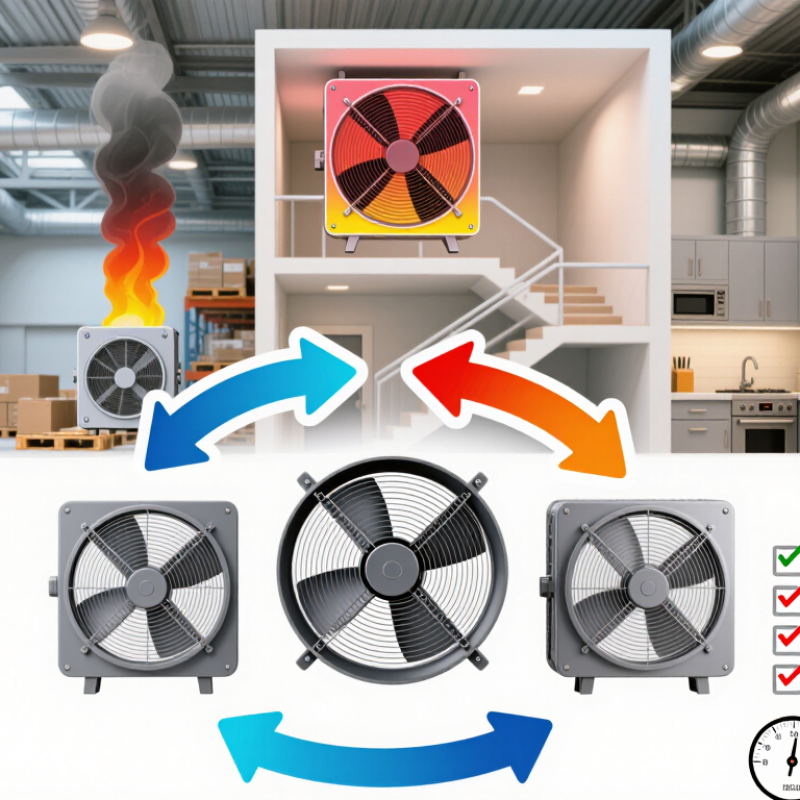
Table of Contents [Hide]
Define the Fire Risks and Performance Needs for Your Application
Choosing a fire-resistant fan begins with the fire, not the catalog. In a plant survey, I look for the likely fuel, ignition source, smoke path, and exposure time. Is the fan serving a commercial kitchen, battery room, furnace area, or smoke-control system? Grease, dust, solvents, and hot gases create different hazards. A fan near a furnace may face radiant heat, while a smoke-extraction fan must keep operating during evacuation. “Fire resistant” is not one universal condition. Ask for the tested temperature and operating duration.
Define the performance target in measurable terms. Record required airflow, static pressure, duct length, damper resistance, and ambient temperature. Include system leakage and dirty-filter conditions; these details often reduce real airflow. Confirm whether the fan must run continuously, start during an alarm, or support emergency extraction. Check motor cooling, shaft seals, bearings, and wiring insulation. A remote motor can reduce heat exposure, but it does not solve every fire scenario. Pressure readings matter.
Request test reports, installation limits, maintenance instructions, and certification accepted by the local authority. The fan should match the complete assembly, including ducts, supports, dampers, and controls. Inspect access panels and clearances before purchase. I have seen strong equipment underperform because a damper stuck or a cable overheated. That mistake is easy to miss. Review the design with a fire engineer and ventilation contractor. Recheck assumptions after commissioning, especially airflow at operating temperature.





