


- Home
- A-Z Catalogue
- Products
- Valves
- Cetop
- Manual Directional Valves
- Proportional Valves
- Poppet Valves
- High-Speed Linear Servo Valves
- All High-Speed Linear Servo Valves
- Cetop 10 (NG32) Two Stage Type High Speed Linear Servo Valves – LSVHG-10
- Cetop 10 (NG32) Two Stage Type High Speed Linear Servo Valves – LSVHG-10 (With Fail-Safe)
- Cetop 8 (NG25) Two Stage Type High Speed Linear Servo Valves – LSVHG-06
- Cetop 8 (NG25) Two Stage Type High Speed Linear Servo Valves – LSVHG-06 (With Fail-Safe)
- Cetop 7 (NG16) Two Stage Type High Speed Linear Servo Valves – LSVHG-04
- Cetop 7 (NG16) Two Stage Type High Speed Linear Servo Valves – LSVHG-04 (With Fail-Safe)
- Cetop 5 (NG10) Direct Type High Speed Linear Servo Valves – LSVG-03
- Cetop 5 (NG10) OBE Type Direct Operated Linear Servo Valves – LSVG-03-EH
- Cetop 3 (NG6) OBE Type Direct Operated Linear Servo Valves – LSVG-01-EH
- Pumps
- Pressure control
- Flow Control Valves
- Pressure Control Valves
- All Pressure Control Valves
- Brake Valves
- Direct Relief Valve
- Low Noise Solenoid Controlled Relief Valves
- Low Noise Pilot Operated Relief Valves
- Pilot Operated Relief Valves
- Pressure reducing and relieving valves
- Pressure reducing and check valves
- Pressure control valves
- Remote Control Relief Valves
- Solenoid Controlled Relief Valves – BSG
- Solenoid Controlled Relief Valves – BST
- Unloading relief valves
- Check valves
- Environmental
- Valves
- Hydraulic Systems
- Power pack
- About Us
- Contact
- Blog

Top Film Coating Machine Manufacturers Worldwide
Choosing among the Top Film Coating Machine Manufacturers Worldwide requires more than comparing output rates. A coating pan turning under warm exhaust air may look efficient, yet spray uniformity, drying control, and cleaning access determine whether production stays consistent. Buyers should examine batch range, airflow design, automation, service coverage, and documented validation support. Small details matter.
The market context is broad, not machine-specific. Fortune Business Insights’ Pharmaceutical Equipment Market report tracks growth across a wider equipment category; its figures should not be mistaken for Film Coating Machine sales alone. For technical evaluation, the FDA’s Process Validation: General Principles and Practices guidance sets out process design, qualification, and continued verification. These principles help teams assess whether a machine can repeatedly produce the intended coating, rather than merely meet a brochure’s maximum capacity.
Manufacturing-quality expert W. Edwards Deming is often quoted: “Quality comes not from inspection, but from improvement of the production process.” That idea applies directly to coating operations, where inlet temperature, spray rate, and pan speed interact. Still, it is not a substitute for product-specific trials. A machine that performs well with one formulation may behave differently with another. This comparison will examine manufacturers through engineering capability, process control, compliance support, and service—not headline specifications alone. Some public market estimates remain broad; readers should verify equipment-level claims with suppliers and independent documentation.
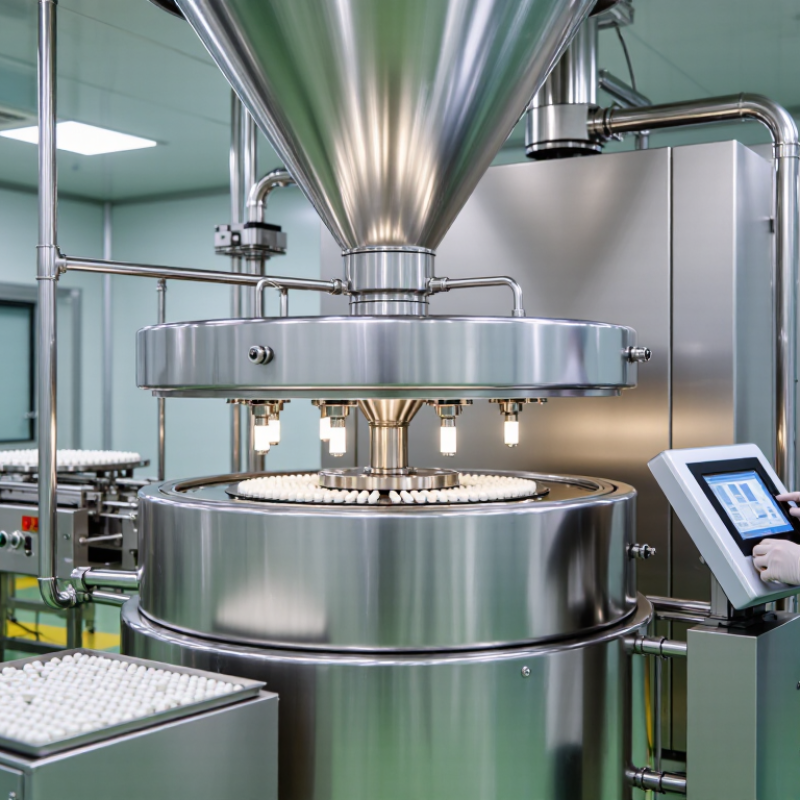
Table of Contents [Hide]
What Film Coating Machines Are and How They Work
A film coating machine applies a thin, even layer to tablets or other solid dosage forms. In a common design, tablets tumble inside a rotating perforated drum. Warm, filtered air passes through the moving bed, while spray guns atomize a coating liquid onto each surface. The drum’s motion helps expose different sides. Small details matter.
During operation, the operator balances pan speed, spray rate, air temperature, and airflow. If spraying exceeds drying capacity, tablets may stick or develop rough patches. If drying is too rapid, the coating can look uneven. Sensors and process records help teams monitor conditions, but readings still need context. A temperature reading alone may not describe the whole tablet bed.
The coating may protect a tablet, improve its appearance, or help control how it dissolves, depending on the formulation. Operators often check sample tablets for color consistency, surface defects, and weight gain. A brief inspection can catch problems, though it cannot replace validated testing. Real equipment also behaves differently with varying batch sizes and coating liquids. That variation is easy to underestimate.