


- Home
- A-Z Catalogue
- Products
- Valves
- Cetop
- Manual Directional Valves
- Proportional Valves
- Poppet Valves
- High-Speed Linear Servo Valves
- All High-Speed Linear Servo Valves
- Cetop 10 (NG32) Two Stage Type High Speed Linear Servo Valves – LSVHG-10
- Cetop 10 (NG32) Two Stage Type High Speed Linear Servo Valves – LSVHG-10 (With Fail-Safe)
- Cetop 8 (NG25) Two Stage Type High Speed Linear Servo Valves – LSVHG-06
- Cetop 8 (NG25) Two Stage Type High Speed Linear Servo Valves – LSVHG-06 (With Fail-Safe)
- Cetop 7 (NG16) Two Stage Type High Speed Linear Servo Valves – LSVHG-04
- Cetop 7 (NG16) Two Stage Type High Speed Linear Servo Valves – LSVHG-04 (With Fail-Safe)
- Cetop 5 (NG10) Direct Type High Speed Linear Servo Valves – LSVG-03
- Cetop 5 (NG10) OBE Type Direct Operated Linear Servo Valves – LSVG-03-EH
- Cetop 3 (NG6) OBE Type Direct Operated Linear Servo Valves – LSVG-01-EH
- Pumps
- Pressure control
- Flow Control Valves
- Pressure Control Valves
- All Pressure Control Valves
- Brake Valves
- Direct Relief Valve
- Low Noise Solenoid Controlled Relief Valves
- Low Noise Pilot Operated Relief Valves
- Pilot Operated Relief Valves
- Pressure reducing and relieving valves
- Pressure reducing and check valves
- Pressure control valves
- Remote Control Relief Valves
- Solenoid Controlled Relief Valves – BSG
- Solenoid Controlled Relief Valves – BST
- Unloading relief valves
- Check valves
- Environmental
- Valves
- Hydraulic Systems
- Power pack
- About Us
- Contact
- Blog

What Is Tissue Tape and What Is It Used For?
Tissue Tape is a thin pressure-sensitive adhesive tape with a paper-like tissue carrier. The carrier adds flexibility while supporting clean cutting, handling, and bonding. Most versions use acrylic or rubber-based adhesives. They may be single-sided or double-sided, depending on the application.
This tape appears in retail displays, envelopes, labels, bookbinding, textile work, and light assembly. A double-sided grade can hold foam, fabric, paper, or plastic against a smooth surface. Imagine mounting a product card without visible fasteners. The result looks neat, but surface preparation still matters. Dust, moisture, low temperature, and rough textures can weaken the bond.
Industry reports show why these small tapes remain commercially important. Smithers’ The Future of Global Adhesive Tapes to 2028 identifies packaging, construction, transport, and electronics as major demand areas. Grand View Research’s Adhesive Tapes Market Size, Share and Trends Analysis Report also highlights growing use in manufacturing and converting applications. These reports discuss the broader adhesive tape market, not Tissue Tape alone. That distinction matters.
Technical performance depends on adhesive chemistry, carrier weight, liner design, and application pressure. 3M technical data sheets commonly evaluate adhesion, peel strength, temperature resistance, and aging behavior. However, one attractive specification does not guarantee real-world success. A tape can bond strongly in testing and fail on a dusty carton.
This guide explains what Tissue Tape is, how it works, and where it performs best. It also considers its limits. Sometimes, the simplest tape is not the right tape.
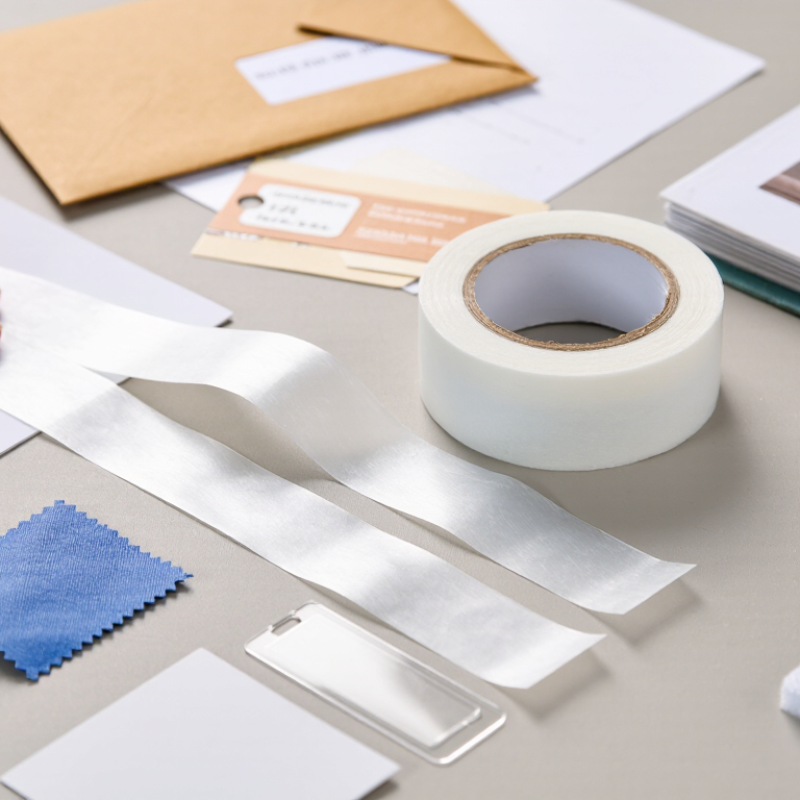
Table of Contents [Hide]
Definition and Basic Features of Tissue Tape
Tissue tape is a pressure-sensitive adhesive tape with a thin, nonwoven paper-like carrier. The carrier gives the tape flexibility and easy tearing. It also keeps the tape lightweight. Unlike plastic film tape, tissue tape can conform to curved surfaces with less visible bulk. Its adhesive layer may be single-sided or double-sided, depending on the application. Thin, but useful.
Basic features include clean cutting, fast bonding, and reasonable surface conformity. Many grades support paper, cardboard, textiles, foam, and selected plastics. However, performance changes with temperature, dust, moisture, and surface energy.
A smooth wall may accept the tape quickly. A dusty carton may not.
ASTM D3330 provides common peel-adhesion methods for pressure-sensitive tapes, helping manufacturers compare bonding performance under controlled conditions. Real performance still requires application testing.
Tissue tape is used for mounting, splicing, labeling, envelope production, insulation assembly, and temporary positioning. Double-sided versions can attach lightweight panels without visible fasteners. In packaging, its low thickness helps maintain a neat appearance.
According to Grand View Research’s 2024 adhesive tapes market analysis, the global market was estimated at approximately USD 76.8 billion in 2023. This broad market includes tissue, film, foil, and other tape structures, so the figure does not represent tissue tape alone. That distinction matters. A tape may look suitable, yet fail after several hours. Check adhesion, liner release, aging, and removal marks before routine use.