


- Home
- A-Z Catalogue
- Products
- Valves
- Cetop
- Manual Directional Valves
- Proportional Valves
- Poppet Valves
- High-Speed Linear Servo Valves
- All High-Speed Linear Servo Valves
- Cetop 10 (NG32) Two Stage Type High Speed Linear Servo Valves – LSVHG-10
- Cetop 10 (NG32) Two Stage Type High Speed Linear Servo Valves – LSVHG-10 (With Fail-Safe)
- Cetop 8 (NG25) Two Stage Type High Speed Linear Servo Valves – LSVHG-06
- Cetop 8 (NG25) Two Stage Type High Speed Linear Servo Valves – LSVHG-06 (With Fail-Safe)
- Cetop 7 (NG16) Two Stage Type High Speed Linear Servo Valves – LSVHG-04
- Cetop 7 (NG16) Two Stage Type High Speed Linear Servo Valves – LSVHG-04 (With Fail-Safe)
- Cetop 5 (NG10) Direct Type High Speed Linear Servo Valves – LSVG-03
- Cetop 5 (NG10) OBE Type Direct Operated Linear Servo Valves – LSVG-03-EH
- Cetop 3 (NG6) OBE Type Direct Operated Linear Servo Valves – LSVG-01-EH
- Pumps
- Pressure control
- Flow Control Valves
- Pressure Control Valves
- All Pressure Control Valves
- Brake Valves
- Direct Relief Valve
- Low Noise Solenoid Controlled Relief Valves
- Low Noise Pilot Operated Relief Valves
- Pilot Operated Relief Valves
- Pressure reducing and relieving valves
- Pressure reducing and check valves
- Pressure control valves
- Remote Control Relief Valves
- Solenoid Controlled Relief Valves – BSG
- Solenoid Controlled Relief Valves – BST
- Unloading relief valves
- Check valves
- Environmental
- Valves
- Hydraulic Systems
- Power pack
- About Us
- Contact
- Blog

China Top 10 Palletizing Machine Manufacturers?
China has become a major source of automated packaging equipment for factories worldwide. Its manufacturers serve food, beverage, chemical, logistics, and consumer goods industries. This guide introduces ten notable Chinese Palletizing Machine manufacturers. It focuses on practical performance, not promotional claims.
The selection considers machine speed, payload range, robotic accuracy, control systems, and integration experience. It also examines factory capabilities, export history, technical support, and available certifications. A reliable supplier should explain cycle times clearly. It should also provide layout drawings, safety details, and realistic delivery schedules. Small details matter, such as gripper changes, pallet sensors, and access to spare parts.
No ranking is perfect. Public information differs between companies. Some manufacturers publish impressive case studies but provide limited technical evidence. Others have strong engineering teams but weaker international communication. Therefore, this list should support further supplier verification rather than replace it. Buyers should request sample testing with their actual cartons, bags, or containers. They should inspect load stability after transport and confirm service response times.
The featured companies represent different strengths. Some focus on high-speed robotic cells. Others specialize in heavy-duty layer palletizing or customized production lines. Their solutions may suit different factory sizes and budgets. A low purchase price can become expensive when integration is poor. Likewise, advanced equipment may be unnecessary for a simple, stable line.
This introduction prepares readers to compare China’s leading manufacturers with greater confidence. It emphasizes evidence, application fit, and long-term operating value. Real results depend on proper installation and operator training. That point is easy to overlook.
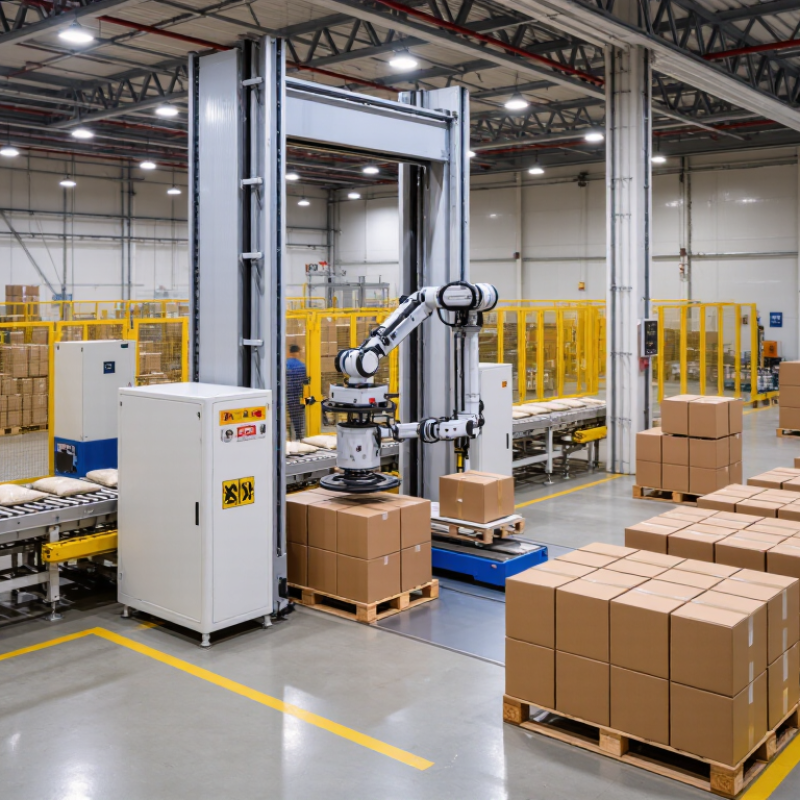
Table of Contents [Hide]
What Defines a Palletizing Machine: 20–40 Cycles per Minute and 10–50 kg Payloads
China Top 10 Palletizing Machine Manufacturers?
What Defines a Palletizing Machine: 20–40 Cycles per Minute and 10–50 kg Payloads
A palletizing machine is defined by more than a catalogue photograph. In practical production, 20–40 cycles per minute is a useful mid-range benchmark. It suits many food, chemical, building material, and consumer goods lines. Each cycle may include gripping, lifting, turning, and placing one case. That number matters. A machine rated at 40 cycles may achieve less with unstable cartons or irregular bags.
Payload also changes the engineering requirements. A 10 kg carton needs different tooling from a 50 kg sack. Heavier loads demand stronger arms, rigid frames, and carefully controlled acceleration. Vacuum grippers work well with sealed, smooth boxes. Fork or clamp tools may perform better with porous bags. Small details affect the entire pallet pattern.
When comparing Chinese manufacturers, buyers should request live tests with their own products. Check layer accuracy, corner alignment, changeover time, and recovery after an emergency stop. Ask for cycle data under full payload, not empty fixtures. Noise, dust protection, and access for maintenance deserve attention too. I have seen impressive demonstrations fail during mixed-size production. That is an uncomfortable point. A lower-speed machine can sometimes deliver better uptime and fewer damaged packages. Operators should also review training, spare-part availability, software access, and documented safety procedures before signing a purchase contract.