


- Home
- A-Z Catalogue
- Products
- Valves
- Cetop
- Manual Directional Valves
- Proportional Valves
- Poppet Valves
- High-Speed Linear Servo Valves
- All High-Speed Linear Servo Valves
- Cetop 10 (NG32) Two Stage Type High Speed Linear Servo Valves – LSVHG-10
- Cetop 10 (NG32) Two Stage Type High Speed Linear Servo Valves – LSVHG-10 (With Fail-Safe)
- Cetop 8 (NG25) Two Stage Type High Speed Linear Servo Valves – LSVHG-06
- Cetop 8 (NG25) Two Stage Type High Speed Linear Servo Valves – LSVHG-06 (With Fail-Safe)
- Cetop 7 (NG16) Two Stage Type High Speed Linear Servo Valves – LSVHG-04
- Cetop 7 (NG16) Two Stage Type High Speed Linear Servo Valves – LSVHG-04 (With Fail-Safe)
- Cetop 5 (NG10) Direct Type High Speed Linear Servo Valves – LSVG-03
- Cetop 5 (NG10) OBE Type Direct Operated Linear Servo Valves – LSVG-03-EH
- Cetop 3 (NG6) OBE Type Direct Operated Linear Servo Valves – LSVG-01-EH
- Pumps
- Pressure control
- Flow Control Valves
- Pressure Control Valves
- All Pressure Control Valves
- Brake Valves
- Direct Relief Valve
- Low Noise Solenoid Controlled Relief Valves
- Low Noise Pilot Operated Relief Valves
- Pilot Operated Relief Valves
- Pressure reducing and relieving valves
- Pressure reducing and check valves
- Pressure control valves
- Remote Control Relief Valves
- Solenoid Controlled Relief Valves – BSG
- Solenoid Controlled Relief Valves – BST
- Unloading relief valves
- Check valves
- Environmental
- Valves
- Hydraulic Systems
- Power pack
- About Us
- Contact
- Blog

What Are the Top 10 Types of Touch Switch?
Touch controls are moving from premium appliances into ordinary homes, offices, and public buildings. Grand View Research estimated the global smart home market at USD 127.8 billion in 2023 and projected a 27.0% compound annual growth rate through 2030. That estimate covers a broad market, not Touch Switches alone. Still, it signals why designers are paying closer attention to the controls people use every day.
A Touch Switch responds to a finger or conductive object rather than relying on a conventional moving button. That small change can affect cleaning, installation, feedback, durability, and compatibility with different loads. It also creates trade-offs. A glossy panel may look neat, yet prove difficult to use with wet hands or in bright light. The details matter.
This guide compares ten common types, including capacitive, resistive, piezoelectric, infrared, and proximity-based designs. It also considers practical differences such as sensing method, surface material, operating environment, and typical application. These categories can overlap, and product terminology is not always consistent. That deserves a careful look. The aim is not to declare one type universally best, but to explain what each design does well, where it can fall short, and what buyers should verify in a product datasheet before choosing.
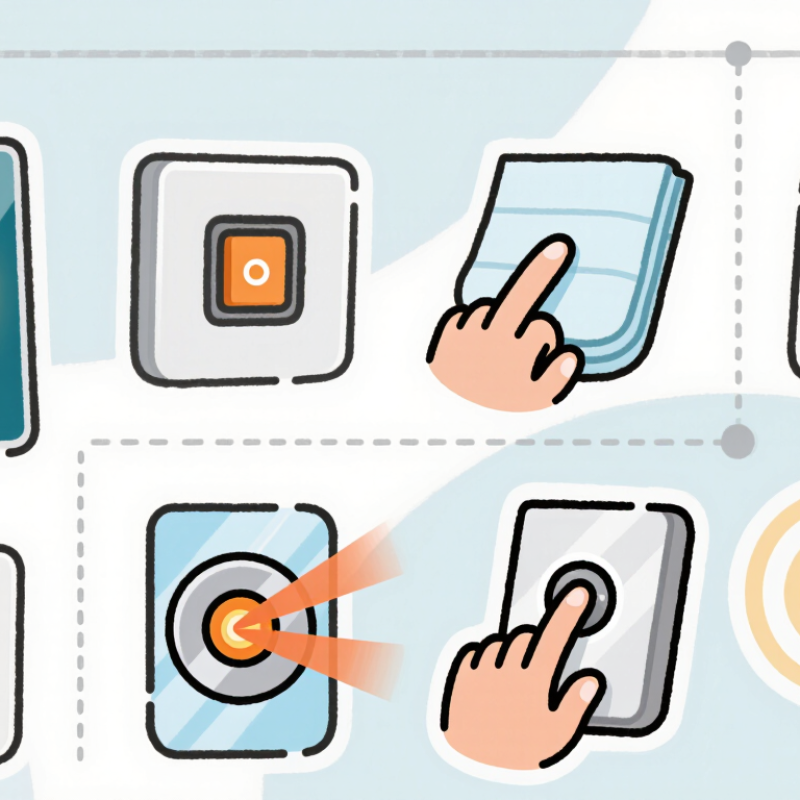
Table of Contents [Hide]
Touch Switch Taxonomy: 10 Types Classified by Their Sensing Principles
Touch switches are grouped by how they detect a finger, not just by their glass or plastic surface. Capacitive self-capacitance sensing detects a change in an electrode’s electric field; mutual-capacitance sensing measures a change between paired electrodes. Resistive switches respond when pressure pushes two conductive layers together. Force-sensitive resistors and strain-based sensors also react to pressure, but measure changing resistance or deformation. They can suit gloved hands, though their feel and durability depend on construction.
Other principles use different physical clues. Surface acoustic wave switches detect disturbances in sound waves traveling across a panel. Infrared beam systems register a finger interrupting a light path, while reflective optical systems detect light returned from a nearby object. Piezoelectric sensors generate a small electrical signal when pressed. Inductive switches detect changes in a magnetic field near a conductive target, and thermal touch sensors respond to heat from a finger. Thermal sensing is less common, and room temperature can complicate readings. These ten categories can overlap in practical designs, so the label alone does not guarantee performance.
Tips: Match the sensing principle to the surface and environment. For example, moisture may affect some capacitive panels, while a mechanical pressure switch needs enough force. Test with the actual enclosure, gloves, and expected lighting. One detail is easy to miss: a sensor that works on a clean bench may behave differently behind thick glass.