


- Home
- A-Z Catalogue
- Products
- Valves
- Cetop
- Manual Directional Valves
- Proportional Valves
- Poppet Valves
- High-Speed Linear Servo Valves
- All High-Speed Linear Servo Valves
- Cetop 10 (NG32) Two Stage Type High Speed Linear Servo Valves – LSVHG-10
- Cetop 10 (NG32) Two Stage Type High Speed Linear Servo Valves – LSVHG-10 (With Fail-Safe)
- Cetop 8 (NG25) Two Stage Type High Speed Linear Servo Valves – LSVHG-06
- Cetop 8 (NG25) Two Stage Type High Speed Linear Servo Valves – LSVHG-06 (With Fail-Safe)
- Cetop 7 (NG16) Two Stage Type High Speed Linear Servo Valves – LSVHG-04
- Cetop 7 (NG16) Two Stage Type High Speed Linear Servo Valves – LSVHG-04 (With Fail-Safe)
- Cetop 5 (NG10) Direct Type High Speed Linear Servo Valves – LSVG-03
- Cetop 5 (NG10) OBE Type Direct Operated Linear Servo Valves – LSVG-03-EH
- Cetop 3 (NG6) OBE Type Direct Operated Linear Servo Valves – LSVG-01-EH
- Pumps
- Pressure control
- Flow Control Valves
- Pressure Control Valves
- All Pressure Control Valves
- Brake Valves
- Direct Relief Valve
- Low Noise Solenoid Controlled Relief Valves
- Low Noise Pilot Operated Relief Valves
- Pilot Operated Relief Valves
- Pressure reducing and relieving valves
- Pressure reducing and check valves
- Pressure control valves
- Remote Control Relief Valves
- Solenoid Controlled Relief Valves – BSG
- Solenoid Controlled Relief Valves – BST
- Unloading relief valves
- Check valves
- Environmental
- Valves
- Hydraulic Systems
- Power pack
- About Us
- Contact
- Blog

Top 10 Types of Ultrapure Water Equipment for Global Buyers
Choosing the right Ultrapure Water Equipment is a technical decision, not merely a purchasing exercise. Laboratories, semiconductor plants, hospitals, and pharmaceutical facilities require water with tightly controlled resistivity, conductivity, organic carbon, particles, and microbial levels. A system that performs well in a research laboratory may fail under continuous industrial demand. Capacity matters. So does maintenance.
Global buyers often compare reverse osmosis systems, electrodeionization units, ultrafiltration modules, UV sterilizers, polishing cartridges, and complete ultrapure water dispensers. Each type addresses a different stage of purification. For example, reverse osmosis may reduce dissolved salts and particles, while a final polishing unit can produce water suitable for sensitive analytical instruments. A visible display is useful, but verified performance data matters more.
This guide examines ten common equipment types and explains where each one fits. It considers feed-water quality, daily volume, installation space, consumables, validation records, and after-sales support. These details affect the total cost long after delivery. Buyers should also review recognized testing methods and request recent certificates from suppliers. Marketing language can sound impressive. It is not always enough.
Real facilities are less tidy than brochures suggest. Filters clog earlier than expected. Operators make mistakes. A reliable design includes alarms, clear replacement instructions, and service access. No single machine suits every site. Careful selection begins with measurable water requirements and honest conversations with qualified manufacturers. That approach supports safer operation, consistent results, and more defensible purchasing decisions across international markets.
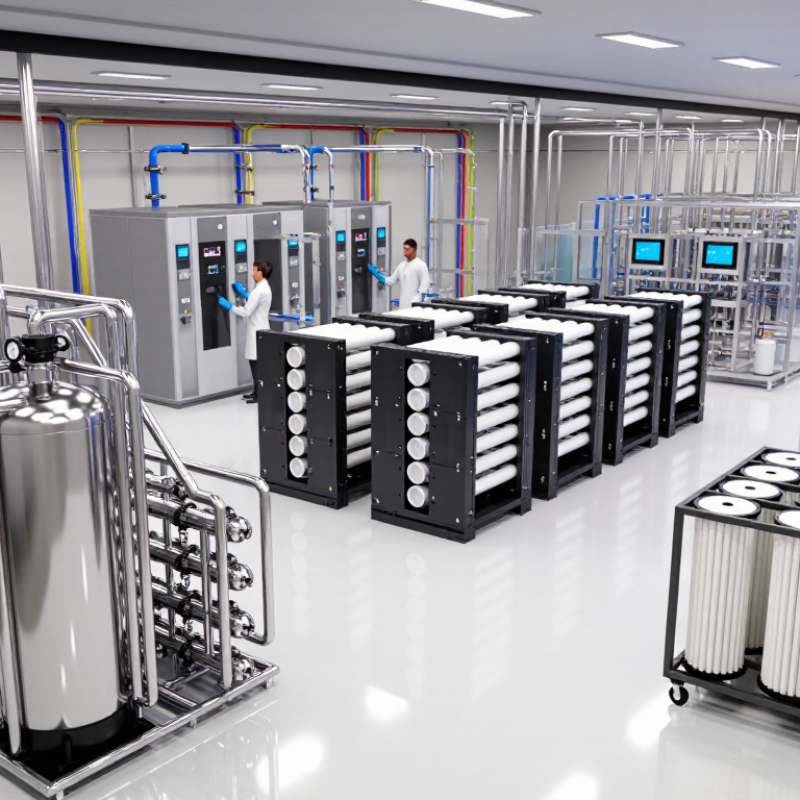
Table of Contents [Hide]
What Defines Ultrapure Water Equipment for Global Buyers
Top 10 Types of Ultrapure Water Equipment for Global Buyers
Ultrapure water equipment is defined by water quality, process control, and verified performance. It is not simply a large filter with a polished appearance. In many laboratories, ultrapure water reaches 18.2 megohm-centimeters at 25°C. However, resistivity alone does not prove suitability. Total organic carbon, particles, bacteria, and endotoxins may also require control.
Global buyers should examine the complete treatment path. Pretreatment protects membranes from sediment, hardness, and chlorine. Reverse osmosis reduces dissolved contaminants. Deionization, ultraviolet treatment, ultrafiltration, and final polishing address different risks. Each stage needs documented specifications, realistic flow rates, and compatible materials. A stainless-steel loop may support distribution, while point-of-use filters protect sensitive applications.
The intended use defines the equipment. Cell culture, chromatography, semiconductor cleaning, and analytical testing demand different quality controls. Reliable systems include calibrated sensors, alarm records, sampling points, and maintenance instructions. They should also explain how performance changes with feed-water temperature and seasonal quality. Local technicians matter, especially when replacement parts cross borders.
A perfect specification can still fail in daily operation. I have seen systems perform well during commissioning but drift after neglected filter changes. Buyers should request validation data, service intervals, and contamination-control procedures. They should question unclear claims. Lower purchase cost may bring higher operating risk, particularly where water quality varies sharply. Good equipment makes quality measurable, repeatable, and practical for the people using it.