


- Home
- A-Z Catalogue
- Products
- Valves
- Cetop
- Manual Directional Valves
- Proportional Valves
- Poppet Valves
- High-Speed Linear Servo Valves
- All High-Speed Linear Servo Valves
- Cetop 10 (NG32) Two Stage Type High Speed Linear Servo Valves – LSVHG-10
- Cetop 10 (NG32) Two Stage Type High Speed Linear Servo Valves – LSVHG-10 (With Fail-Safe)
- Cetop 8 (NG25) Two Stage Type High Speed Linear Servo Valves – LSVHG-06
- Cetop 8 (NG25) Two Stage Type High Speed Linear Servo Valves – LSVHG-06 (With Fail-Safe)
- Cetop 7 (NG16) Two Stage Type High Speed Linear Servo Valves – LSVHG-04
- Cetop 7 (NG16) Two Stage Type High Speed Linear Servo Valves – LSVHG-04 (With Fail-Safe)
- Cetop 5 (NG10) Direct Type High Speed Linear Servo Valves – LSVG-03
- Cetop 5 (NG10) OBE Type Direct Operated Linear Servo Valves – LSVG-03-EH
- Cetop 3 (NG6) OBE Type Direct Operated Linear Servo Valves – LSVG-01-EH
- Pumps
- Pressure control
- Flow Control Valves
- Pressure Control Valves
- All Pressure Control Valves
- Brake Valves
- Direct Relief Valve
- Low Noise Solenoid Controlled Relief Valves
- Low Noise Pilot Operated Relief Valves
- Pilot Operated Relief Valves
- Pressure reducing and relieving valves
- Pressure reducing and check valves
- Pressure control valves
- Remote Control Relief Valves
- Solenoid Controlled Relief Valves – BSG
- Solenoid Controlled Relief Valves – BST
- Unloading relief valves
- Check valves
- Environmental
- Valves
- Hydraulic Systems
- Power pack
- About Us
- Contact
- Blog

China Top 10 Pallet Transfer Conveyor Manufacturers?
Selecting reliable equipment suppliers requires more than comparing factory photos or advertised prices. This introduction explores China’s Top 10 Pallet Transfer Conveyor Manufacturers through practical purchasing criteria, including engineering experience, product quality, customization capability, and after-sales support. A Pallet Transfer Conveyor must move heavy loads smoothly, accurately, and safely across production lines. Its performance affects warehouse flow, labor efficiency, and equipment maintenance.
The evaluation considers manufacturers serving industries such as automotive parts, packaging, warehousing, food processing, and general material handling. Key details include conveyor frame construction, roller or chain design, transfer speed, load capacity, control systems, and integration with existing automation. Certifications, testing records, installation experience, and customer references also deserve careful attention. A supplier may offer advanced technology, but poor documentation can still create avoidable delays.
No list is perfect. Rankings can change.
Market information is often incomplete, and some manufacturers present similar product claims. Therefore, readers should verify current factory capabilities, export experience, response times, and spare-parts availability before signing a contract. Site visits, video inspections, sample testing, and clear technical drawings can reveal differences that brochures hide. In real projects, small details matter, such as transfer height, pallet dimensions, sensor placement, noise levels, and cleaning access. This guide aims to provide a balanced starting point, not an unquestionable verdict. It combines observable industry factors with practical procurement concerns, while recognizing that the best manufacturer depends on the application, budget, timeline, and required automation level. Some conclusions may need revision after direct supplier audits. That is part of responsible research.
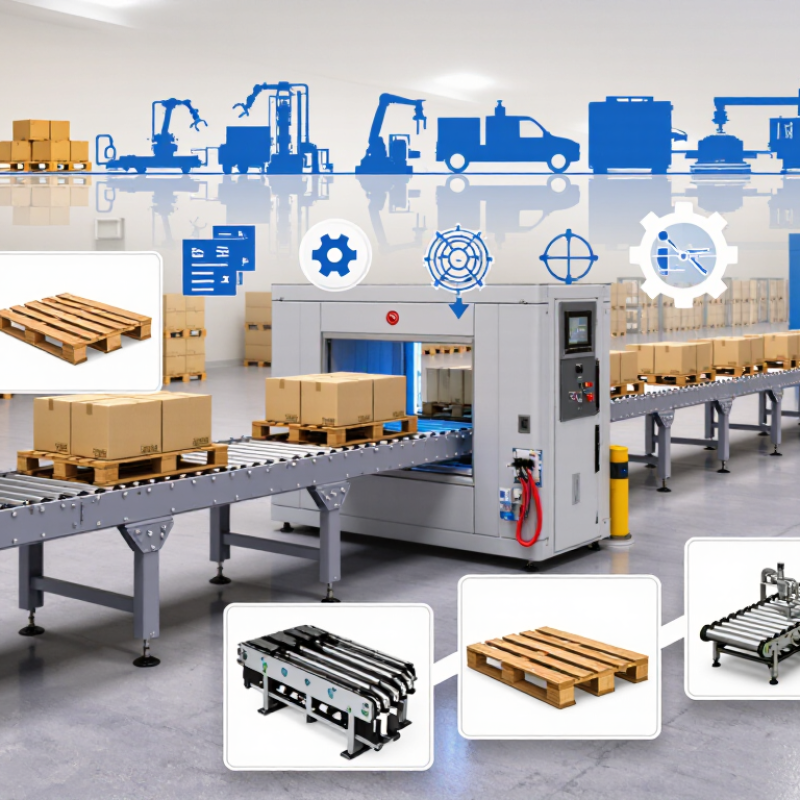
Table of Contents [Hide]
What Is a Pallet Transfer Conveyor?
A pallet transfer conveyor is a powered or automated system that moves pallets between conveyor lines, workstations, storage areas, or production zones. It changes a pallet’s direction without requiring manual handling. Common designs use chains, rollers, belts, lift tables, or shuttle platforms.
In a warehouse, a pallet may travel forward, stop, rise slightly, and move sideways onto another line. Sensors confirm its position before the transfer begins. This prevents collisions and reduces product movement during handling. The conveyor frame must support the pallet’s weight, load balance, and operating speed. A weak frame can create vibration, noise, and costly delays.
Experienced integrators check pallet dimensions, floor conditions, transfer height, and control signals before selecting equipment. They also examine access for cleaning and maintenance. Emergency stops and guarded moving parts support safer operation. In practice, the first layout is rarely perfect. Small clearance errors can cause large problems. A test pallet should run through every transfer point before full production starts. Operators should record jams, unusual sounds, and sensor failures during trials. This evidence helps improve reliability and makes future supplier comparisons more objective.
China Top 10 Pallet Transfer Conveyor Manufacturers? - What Is a Pallet Transfer Conveyor?
A pallet transfer conveyor is a material-handling system that moves pallets between conveyor lines, production areas, storage locations, or loading points. The table below compares ten widely used pallet-transfer configurations without displaying company or brand information.
| No. | Pallet Transfer Configuration | Transfer Principle | Typical Load Capacity | Best Transfer Direction | Main Advantages | Typical Applications |
|---|---|---|---|---|---|---|
| 1 | Chain Transfer Conveyor | Parallel chains lift or carry the pallet and move it to an adjacent line. | Approximately 500–2,000 kg | 90° transfer | Strong load support, reliable positioning, and suitable for heavy or rigid-bottom pallets. | Automotive components, warehouse staging, production lines, and heavy manufacturing. |
| 2 | Pop-Up Roller Transfer | Powered rollers rise above the main conveyor surface, move the pallet sideways, and retract afterward. | Approximately 300–1,500 kg | 90° transfer | Compact design, easy integration, and minimal interference with the main conveying route. | Distribution centers, packaging lines, pallet sorting, and cross-docking systems. |
| 3 | Scissor Lift Transfer Table | A powered lift platform raises or lowers a pallet to match different conveyor elevations. | Approximately 500–3,000 kg | Vertical or level change | Handles substantial height differences and can combine lifting with roller or chain transfer. | Multi-level warehouses, loading docks, assembly cells, and platform interfaces. |
| 4 | Turntable Pallet Conveyor | A rotating platform changes the pallet’s travel direction while maintaining a fixed transfer point. | Approximately 500–2,000 kg | 90° or 180° turn | Flexible routing, smooth direction changes, and efficient use of floor space. | Warehouse loops, palletizing cells, production routing, and order consolidation. |
| 5 | Pallet Shuttle Transfer Unit | A motorized shuttle travels along rails to collect and deliver pallets between parallel lanes. | Approximately 500–1,500 kg | Parallel-lane transfer | High storage density, reduced fixed conveyor length, and automated lane allocation. | High-density storage, cold storage, buffer warehouses, and automated distribution centers. |
| 6 | Belt Transfer Conveyor | A continuous belt carries the pallet or load across a transfer section. | Approximately 100–1,000 kg | Straight or angled transfer | Good traction, controlled acceleration, and suitability for unstable or uneven loads. | Cartonized pallets, clean production environments, packaging, and unit-load handling. |
| 7 | Roller Conveyor Transfer Section | Motor-driven rollers provide the conveying force and can be arranged as a dedicated transfer module. | Approximately 300–2,000 kg | Straight-line transfer | Modular construction, accessible maintenance, and compatibility with sensors and stops. | General warehousing, manufacturing, shipping, receiving, and accumulation zones. |
| 8 | Pallet Lift and Transfer Conveyor | A lift mechanism raises the pallet, transfers it at an upper level, and lowers it onto a destination conveyor. | Approximately 500–2,500 kg | Vertical plus horizontal | Connects separate elevations without a long ramp and supports automated routing. | Building-to-building links, mezzanines, production floors, and vertical warehouse systems. |
| 9 | AGV Interface Transfer Conveyor | A fixed conveyor exchanges pallets with an automated guided vehicle or autonomous mobile robot. | Approximately 300–1,500 kg | Point-to-point transfer | Supports flexible automation, reduced manual handling, and software-controlled material flow. | Smart factories, line-side delivery, finished-goods movement, and automated warehouses. |
| 10 | Pallet Accumulation Transfer Conveyor | Controlled zones store and release pallets individually or in groups before transfer to the next process. | Approximately 300–2,000 kg | Inline or zoned transfer | Buffers production differences, reduces blockage, and enables controlled pallet release. | Food and beverage, consumer goods, packaging, dispatch, and warehouse buffering. |
Selection note: Actual capacity depends on pallet dimensions, load distribution, conveyor width, speed, duty cycle, transfer frequency, floor conditions, safety requirements, and the chosen drive and structural design. The capacity ranges shown are general engineering reference values rather than guaranteed specifications.