


- Home
- A-Z Catalogue
- Products
- Valves
- Cetop
- Manual Directional Valves
- Proportional Valves
- Poppet Valves
- High-Speed Linear Servo Valves
- All High-Speed Linear Servo Valves
- Cetop 10 (NG32) Two Stage Type High Speed Linear Servo Valves – LSVHG-10
- Cetop 10 (NG32) Two Stage Type High Speed Linear Servo Valves – LSVHG-10 (With Fail-Safe)
- Cetop 8 (NG25) Two Stage Type High Speed Linear Servo Valves – LSVHG-06
- Cetop 8 (NG25) Two Stage Type High Speed Linear Servo Valves – LSVHG-06 (With Fail-Safe)
- Cetop 7 (NG16) Two Stage Type High Speed Linear Servo Valves – LSVHG-04
- Cetop 7 (NG16) Two Stage Type High Speed Linear Servo Valves – LSVHG-04 (With Fail-Safe)
- Cetop 5 (NG10) Direct Type High Speed Linear Servo Valves – LSVG-03
- Cetop 5 (NG10) OBE Type Direct Operated Linear Servo Valves – LSVG-03-EH
- Cetop 3 (NG6) OBE Type Direct Operated Linear Servo Valves – LSVG-01-EH
- Pumps
- Pressure control
- Flow Control Valves
- Pressure Control Valves
- All Pressure Control Valves
- Brake Valves
- Direct Relief Valve
- Low Noise Solenoid Controlled Relief Valves
- Low Noise Pilot Operated Relief Valves
- Pilot Operated Relief Valves
- Pressure reducing and relieving valves
- Pressure reducing and check valves
- Pressure control valves
- Remote Control Relief Valves
- Solenoid Controlled Relief Valves – BSG
- Solenoid Controlled Relief Valves – BST
- Unloading relief valves
- Check valves
- Environmental
- Valves
- Hydraulic Systems
- Power pack
- About Us
- Contact
- Blog

What Is a Copper Busbar Extrusion Machine?
Copper Busbar Extrusion Machine technology sits at an important point between copper processing and modern electrification. It converts heated copper billets into continuous, accurately shaped bars. These bars carry electricity inside switchgear, transformers, battery systems, data centers, and renewable-energy equipment. The process must control temperature, die wear, dimensional tolerance, and surface quality. A small defect can create a costly installation problem.
Demand pressure is increasing. The International Energy Agency’s Global Critical Minerals Outlook 2024 estimates that copper demand may rise from approximately 26 million metric tons in 2023 to about 31 million metric tons by 2035 under its Stated Policies Scenario. S&P Global’s 2024 copper study also warns of a potential supply gap as electrification expands. These figures do not guarantee growth for every equipment supplier. They do show why efficient forming deserves closer attention.
Professor John G. Lenard, a recognized metal-forming authority, defines the basic principle clearly: “Extrusion is a process in which a billet is forced through a die.” That simple sentence hides difficult engineering choices. A modern Copper Busbar Extrusion Machine needs stable hydraulic pressure, precise cooling, automatic length control, and dependable measurement systems. Operators still matter. No machine is perfect. Poor billet preparation, unnoticed die damage, or incorrect alignment can reduce conductivity and increase scrap. The strongest evaluations therefore examine real output, energy use, maintenance access, and repeatability—not impressive brochures alone.
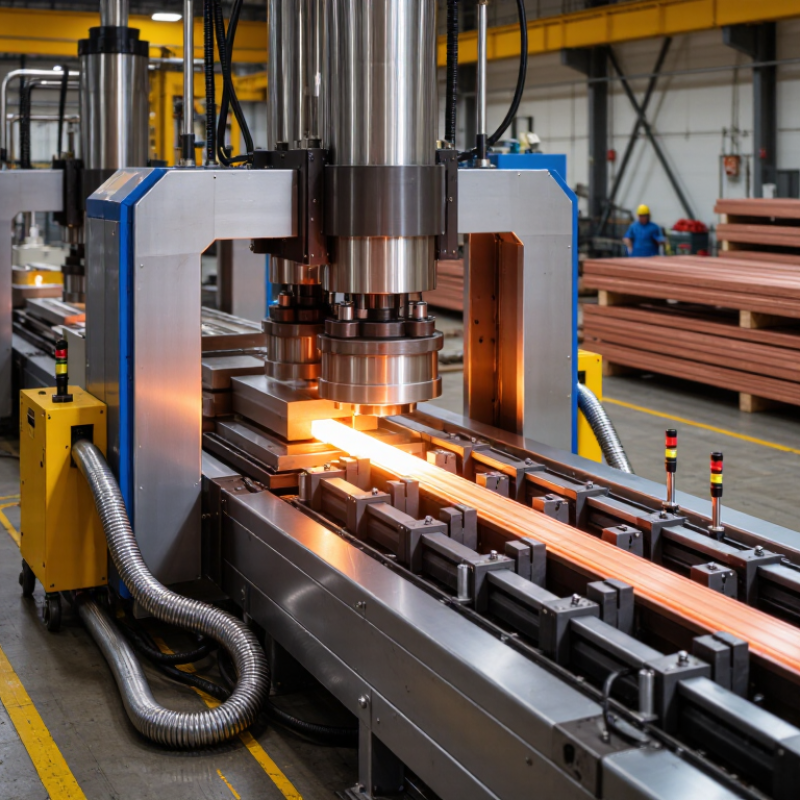
Table of Contents [Hide]
What a Copper Busbar Extrusion Machine Does and Why It Matters
What Is a Copper Busbar Extrusion Machine?
A copper busbar extrusion machine converts heated copper billets into precise, continuous electrical conductors. The billet enters a container and moves through a hardened die. Pressure shapes it into a flat bar, hollow section, or custom profile. Water cooling then stabilizes the dimensions before cutting, straightening, and inspection.
The process matters because busbars carry high currents inside switchgear, battery systems, transformers, and data-center equipment. A small thickness error can create poor contact, uneven heating, or difficult assembly. Good extrusion control reduces scrap and keeps edges cleaner. It also supports consistent conductivity across long production runs.
Practical experience shows that die alignment and cooling speed deserve close attention. They are easy to underestimate.
Industry demand gives this equipment wider importance. The International Energy Agency’s Global Critical Minerals Outlook 2024 projects total copper demand rising from about 26 million tonnes in 2023 to over 31 million tonnes by 2035. The report also expects clean-energy copper demand to grow substantially during that period. The International Copper Study Group reported global refined copper usage near 26 million tonnes in 2023. These figures suggest stronger pressure on productivity, material efficiency, and repeatable quality.
Not every extrusion line performs equally.
Higher speed is not automatically better. Operators still need to balance billet temperature, extrusion pressure, die wear, and surface finish. That judgment remains partly practical, and sometimes imperfect. A reliable machine is valuable because it makes those variables visible, measurable, and easier to correct.





