


- Home
- A-Z Catalogue
- Products
- Valves
- Cetop
- Manual Directional Valves
- Proportional Valves
- Poppet Valves
- High-Speed Linear Servo Valves
- All High-Speed Linear Servo Valves
- Cetop 10 (NG32) Two Stage Type High Speed Linear Servo Valves – LSVHG-10
- Cetop 10 (NG32) Two Stage Type High Speed Linear Servo Valves – LSVHG-10 (With Fail-Safe)
- Cetop 8 (NG25) Two Stage Type High Speed Linear Servo Valves – LSVHG-06
- Cetop 8 (NG25) Two Stage Type High Speed Linear Servo Valves – LSVHG-06 (With Fail-Safe)
- Cetop 7 (NG16) Two Stage Type High Speed Linear Servo Valves – LSVHG-04
- Cetop 7 (NG16) Two Stage Type High Speed Linear Servo Valves – LSVHG-04 (With Fail-Safe)
- Cetop 5 (NG10) Direct Type High Speed Linear Servo Valves – LSVG-03
- Cetop 5 (NG10) OBE Type Direct Operated Linear Servo Valves – LSVG-03-EH
- Cetop 3 (NG6) OBE Type Direct Operated Linear Servo Valves – LSVG-01-EH
- Pumps
- Pressure control
- Flow Control Valves
- Pressure Control Valves
- All Pressure Control Valves
- Brake Valves
- Direct Relief Valve
- Low Noise Solenoid Controlled Relief Valves
- Low Noise Pilot Operated Relief Valves
- Pilot Operated Relief Valves
- Pressure reducing and relieving valves
- Pressure reducing and check valves
- Pressure control valves
- Remote Control Relief Valves
- Solenoid Controlled Relief Valves – BSG
- Solenoid Controlled Relief Valves – BST
- Unloading relief valves
- Check valves
- Environmental
- Valves
- Hydraulic Systems
- Power pack
- About Us
- Contact
- Blog

What Is a Mini Excavator Track Chain?
A Mini Excavator Track Chain is the linked steel assembly that transfers drive power to the crawler shoe. It supports the machine’s weight and maintains contact with uneven ground. Inside the undercarriage, each chain link works with pins, bushings, rollers, and sprocket teeth. Small errors can create expensive problems.
Industry reports show why this component deserves careful attention. Off-Highway Research’s Global Construction Equipment Market report identifies compact excavators as a major equipment segment worldwide. The Association of Equipment Manufacturers also continues to report strong demand for compact construction machinery in North America. These reports measure machines, not individual chains. However, their findings indicate a larger population of undercarriage components requiring inspection and replacement.
A worn Mini Excavator Track Chain may produce loose track tension, unusual vibration, or a clicking sound during travel. A simple visual check can reveal elongated pin joints, damaged bushings, or uneven shoe movement. Experienced technicians also compare sprocket wear with chain pitch. Replacing only one badly worn part may shorten the service life of the entire system. That assumption is not always correct.
Manufacturer service manuals remain the most reliable reference for tension measurements, torque values, and allowable wear limits. ISO and SAE terminology can also prevent confusion when comparing aftermarket components. Still, field conditions complicate every recommendation. Mud, abrasive sand, poor lubrication, and frequent counter-rotation can change actual wear rates. There is no universal replacement interval.
Understanding the chain’s construction helps owners make better maintenance decisions. It also encourages a more realistic question: is the chain failing, or is another undercarriage part causing the symptom?
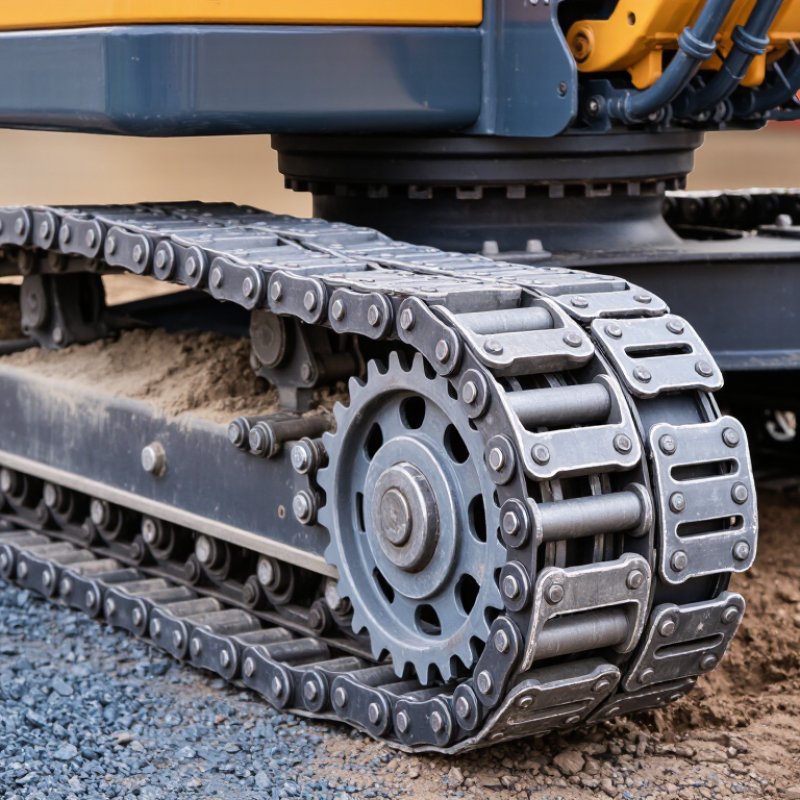
Table of Contents [Hide]
Definition and Basic Function of a Mini Excavator Track Chain
What Is a Mini Excavator Track Chain?
A mini excavator track chain is the linked steel assembly that moves around the undercarriage. It supports the track shoes and works with the drive sprocket, rollers, and idlers. Each link connects through pins and bushings, allowing the chain to bend around the machine’s front and rear ends.
Its basic function is simple but essential. The final drive sends torque to the sprocket, which pulls the chain forward. The chain then carries the track shoes across the ground, creating traction and supporting the excavator’s weight. This system helps the machine travel, turn, and remain stable on soil, gravel, or packed clay.
A worn chain may produce loose tracks, uneven movement, or unusual knocking sounds. A track chain is not the rubber track itself. This difference is easy to miss.
Tips: Check chain tension on level ground after cleaning packed soil from the undercarriage. Inspect pin wear, bushing rotation, cracked links, and missing hardware. Use the service manual for the correct measurement, because “tight” is not a reliable setting. In practice, many operators delay inspection until movement becomes noisy. That habit deserves reconsideration. Regular checks can reveal wear before sprocket teeth and rollers suffer secondary damage. Conditions also matter; mud, abrasive sand, and frequent turning on hard surfaces can shorten component life.





