


- Home
- A-Z Catalogue
- Products
- Valves
- Cetop
- Manual Directional Valves
- Proportional Valves
- Poppet Valves
- High-Speed Linear Servo Valves
- All High-Speed Linear Servo Valves
- Cetop 10 (NG32) Two Stage Type High Speed Linear Servo Valves – LSVHG-10
- Cetop 10 (NG32) Two Stage Type High Speed Linear Servo Valves – LSVHG-10 (With Fail-Safe)
- Cetop 8 (NG25) Two Stage Type High Speed Linear Servo Valves – LSVHG-06
- Cetop 8 (NG25) Two Stage Type High Speed Linear Servo Valves – LSVHG-06 (With Fail-Safe)
- Cetop 7 (NG16) Two Stage Type High Speed Linear Servo Valves – LSVHG-04
- Cetop 7 (NG16) Two Stage Type High Speed Linear Servo Valves – LSVHG-04 (With Fail-Safe)
- Cetop 5 (NG10) Direct Type High Speed Linear Servo Valves – LSVG-03
- Cetop 5 (NG10) OBE Type Direct Operated Linear Servo Valves – LSVG-03-EH
- Cetop 3 (NG6) OBE Type Direct Operated Linear Servo Valves – LSVG-01-EH
- Pumps
- Pressure control
- Flow Control Valves
- Pressure Control Valves
- All Pressure Control Valves
- Brake Valves
- Direct Relief Valve
- Low Noise Solenoid Controlled Relief Valves
- Low Noise Pilot Operated Relief Valves
- Pilot Operated Relief Valves
- Pressure reducing and relieving valves
- Pressure reducing and check valves
- Pressure control valves
- Remote Control Relief Valves
- Solenoid Controlled Relief Valves – BSG
- Solenoid Controlled Relief Valves – BST
- Unloading relief valves
- Check valves
- Environmental
- Valves
- Hydraulic Systems
- Power pack
- About Us
- Contact
- Blog

Why Choose a High Voltage Distribution Box?
Why Choose a High-Voltage Distribution Box?
Modern electrical systems demand more than simple power delivery. They require controlled routing, dependable protection, and clear maintenance access. A High-Voltage Distribution Box brings these functions into one engineered enclosure. It can distribute power between batteries, inverters, motors, chargers, and other high-energy equipment.
The details matter. Strong busbars reduce unnecessary resistance. Insulated barriers limit accidental contact. Proper sealing helps protect internal components from dust, moisture, and vibration. Carefully selected fuses and contactors can interrupt dangerous fault currents before damage spreads. These features support safer operation in electric vehicles, energy-storage systems, industrial machinery, and renewable-energy installations.
Safety comes first.
William Thomson, Lord Kelvin, remains a respected figure in electrical engineering. His often-cited principle states, “If you cannot measure it, you cannot improve it.” This idea fits high-voltage distribution design. Voltage drop, temperature rise, insulation resistance, and fault performance should be tested, not simply assumed.
A qualified manufacturer also considers enclosure materials, thermal behavior, cable routing, service conditions, and installation errors. Experience shows that small design weaknesses can become costly failures. However, no distribution box can compensate for poor system integration or careless maintenance. That limitation deserves attention.
Choosing the right High-Voltage Distribution Box is therefore an engineering decision, not merely a purchasing decision. The best solution balances electrical capacity, protection, durability, serviceability, and verified compliance. It may not be the smallest or cheapest option. It should be the one that performs reliably when the system is stressed.
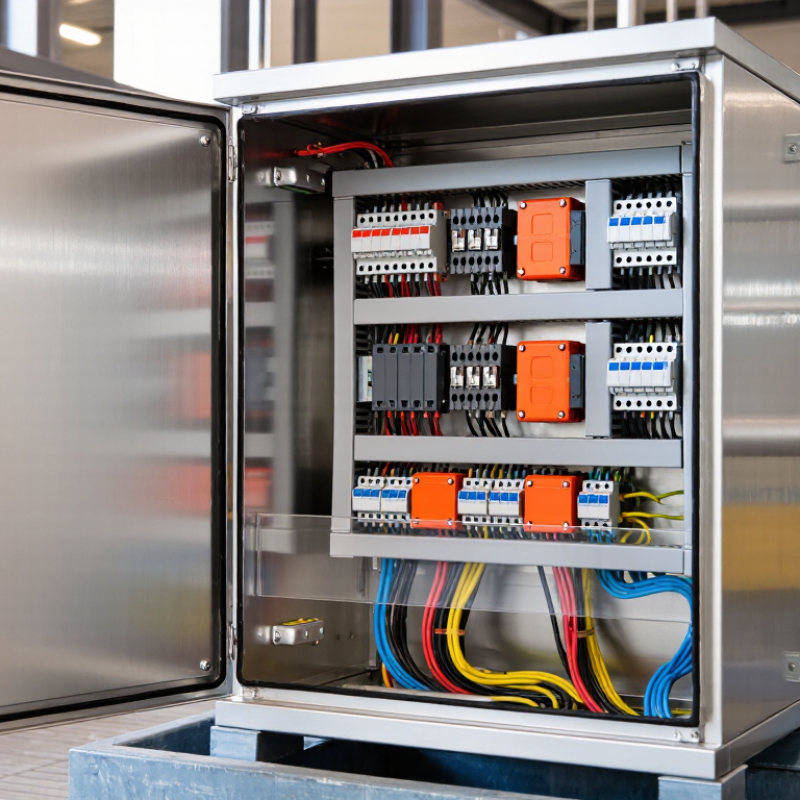
Table of Contents [Hide]
What Is a High Voltage Distribution Box?
A high-voltage distribution box is a protected electrical unit that routes energy from a battery to several high-voltage loads. It is common in electric vehicles, energy storage systems, and industrial equipment. It is central. The box receives direct current, controls its distribution, and helps isolate circuits during faults or maintenance. Unlike a battery pack, it does not store energy. It manages energy flow.
Inside, copper busbars carry substantial current through carefully arranged paths. Fuses protect against short circuits and excessive current. Contactors connect or disconnect the high-voltage supply. A pre-charge circuit limits the initial current entering capacitors, reducing electrical stress. Sensors may monitor voltage, current, temperature, and insulation conditions. Small parts matter. In practical installations, loose terminals, poor sealing, or incorrect cable routing can create serious heating and reliability problems. The enclosure therefore needs suitable insulation, thermal control, and resistance to vibration and moisture.
Choosing a high-voltage distribution box requires more than checking its rated voltage. Engineers should examine continuous current, peak current, fault capacity, connector design, cooling conditions, and service access. Standards and testing requirements also vary by application and region. A box can look robust yet perform poorly if its internal spacing does not match the operating voltage. That mistake is easy to make. Careful validation under real load conditions often reveals weaknesses that a desk review misses. Even a small temperature rise at one connection deserves attention.