


- Home
- A-Z Catalogue
- Products
- Valves
- Cetop
- Manual Directional Valves
- Proportional Valves
- Poppet Valves
- High-Speed Linear Servo Valves
- All High-Speed Linear Servo Valves
- Cetop 10 (NG32) Two Stage Type High Speed Linear Servo Valves – LSVHG-10
- Cetop 10 (NG32) Two Stage Type High Speed Linear Servo Valves – LSVHG-10 (With Fail-Safe)
- Cetop 8 (NG25) Two Stage Type High Speed Linear Servo Valves – LSVHG-06
- Cetop 8 (NG25) Two Stage Type High Speed Linear Servo Valves – LSVHG-06 (With Fail-Safe)
- Cetop 7 (NG16) Two Stage Type High Speed Linear Servo Valves – LSVHG-04
- Cetop 7 (NG16) Two Stage Type High Speed Linear Servo Valves – LSVHG-04 (With Fail-Safe)
- Cetop 5 (NG10) Direct Type High Speed Linear Servo Valves – LSVG-03
- Cetop 5 (NG10) OBE Type Direct Operated Linear Servo Valves – LSVG-03-EH
- Cetop 3 (NG6) OBE Type Direct Operated Linear Servo Valves – LSVG-01-EH
- Pumps
- Pressure control
- Flow Control Valves
- Pressure Control Valves
- All Pressure Control Valves
- Brake Valves
- Direct Relief Valve
- Low Noise Solenoid Controlled Relief Valves
- Low Noise Pilot Operated Relief Valves
- Pilot Operated Relief Valves
- Pressure reducing and relieving valves
- Pressure reducing and check valves
- Pressure control valves
- Remote Control Relief Valves
- Solenoid Controlled Relief Valves – BSG
- Solenoid Controlled Relief Valves – BST
- Unloading relief valves
- Check valves
- Environmental
- Valves
- Hydraulic Systems
- Power pack
- About Us
- Contact
- Blog

Why Are Logistics Trolleys Essential for Global Warehouses?
Why Are Logistics Trolleys Essential for Global Warehouses?
Global warehouses are under pressure to move more goods with fewer delays, errors, and unnecessary handling. MHI’s 2024 Annual Industry Report found that 55% of supply chain leaders planned to increase technology investment. Yet advanced software cannot solve every movement problem. A worker still needs to move cartons safely from a picking shelf to a packing station.
That is where Logistics Trolleys remain practical. They support short-distance movement, reduce repeated lifting, and help organize mixed orders during busy shifts. Wheels, handles, shelves, and brakes may appear simple. Their daily impact is not. A well-designed trolley can reduce walking, protect products, and keep aisles clearer. Small improvements matter.
Gwynne Richards, a recognized warehouse management author and consultant, states, “The warehouse is no longer simply a place for storage; it is a key part of the supply chain.” This view explains why transport equipment deserves careful attention. Logistics Trolleys connect storage, picking, replenishment, and dispatch without requiring complex infrastructure. They also support flexible workflows when demand changes suddenly.
DHL’s Logistics Trend Radar identifies robotics and automation as major forces shaping warehouse operations. However, not every facility can justify full automation. This is an important limitation. Trolleys may not deliver dramatic results in every layout, workforce, or product category. Their value depends on wheel quality, load capacity, route design, maintenance, and operator training.
The strongest case is practical: less carrying, fewer interruptions, and smoother handoffs. Not perfect efficiency. Better consistency.
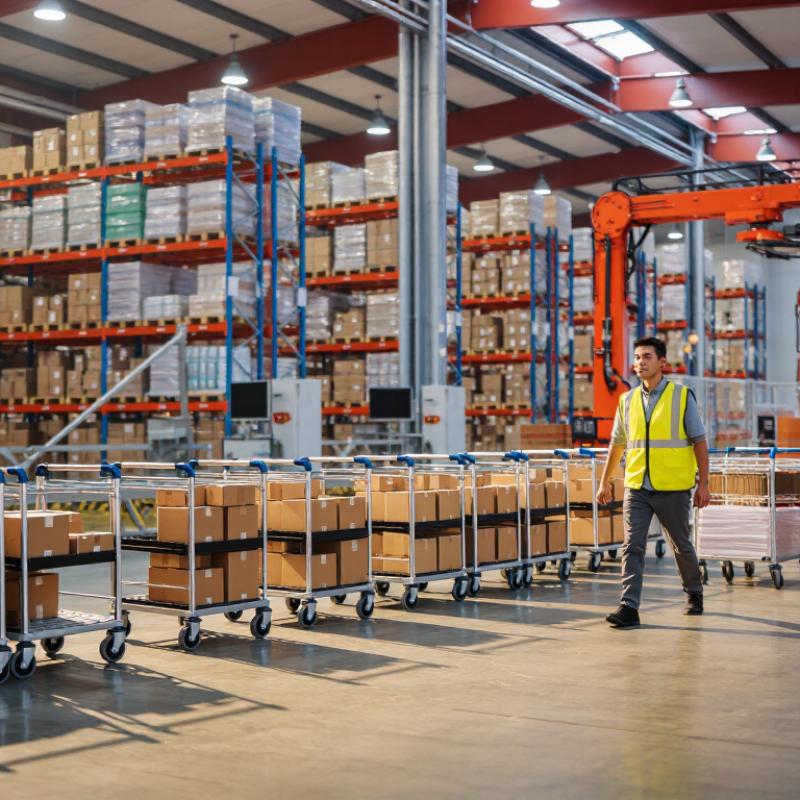
Table of Contents [Hide]
Definition and Role of Logistics Trolleys in Warehouses
A logistics trolley is a wheeled handling tool used to move cartons, bins, totes, and small equipment inside a warehouse. It reduces repeated carrying between receiving docks, storage aisles, picking stations, and packing areas. In practical operations, a well-designed trolley keeps products close to the operator’s hands. That detail saves motion and time.
Its role is more than transportation. Trolleys support batch picking, order consolidation, replenishment, and temporary staging. They also improve visibility because workers can separate orders by shelf, zone, or delivery route. The MHI 2024 Annual Industry Report found that 55% of supply chain professionals expect increased investment in robotics and automation. Yet simple manual equipment remains valuable. It costs less, requires little training, and can adapt when warehouse layouts change. A trolley is not magic. Poor wheel quality, excessive loading, or narrow aisles can create delays and safety risks. The design may also fail when operators have different heights or working habits.
Tips: Choose adjustable handles, smooth casters, strong brakes, and a clear load limit. Test the trolley on ramps, corners, and uneven floors. Measure travel distance before and after use. The result may be smaller than expected, but small gains repeated across thousands of moves can matter. Review the data, not assumptions. A 2023 report from the International Federation of Robotics recorded 553,052 industrial robot installations worldwide, showing rising automation. Manual trolleys still fill the practical gaps between people, shelves, and automated systems.
Why Are Logistics Trolleys Essential for Global Warehouses? - Definition and Role of Logistics Trolleys in Warehouses
| Logistics Trolley Type | Definition and Main Structure | Typical Load Capacity | Common Warehouse Role | Key Operational Benefits | Best-Fit Warehouse Area | Important Selection Criteria |
|---|---|---|---|---|---|---|
| Platform Trolley | A flat load deck mounted on four casters, sometimes fitted with a push handle or removable sides. | 150–500 kg | Moving cartons, totes, tools, and irregularly shaped items over short distances. | Simple operation, flexible loading, low maintenance, and no fuel or battery requirement. | Receiving, dispatch, replenishment, and general storage aisles. | Deck size, caster diameter, turning radius, braking system, and floor condition. |
| Cage Trolley | A wheeled platform enclosed by mesh or tubular side panels to retain loose or stacked goods. | 250–1,000 kg | Handling parcels, garment bags, returns, and mixed loads that require containment. | Reduces falling items, improves load visibility, and supports safer movement of multiple packages. | Parcel sortation, e-commerce fulfillment, returns, and outbound staging. | Mesh opening, number of shelves, door design, stackability, and load distribution. |
| Roll Container | A collapsible or fixed wheeled frame with two or three sides, usually designed for standardized handling. | 250–800 kg | Moving standardized roll loads between storage, picking, staging, and loading areas. | Efficient space use, fast loading and unloading, and easier route-based material flow. | Retail distribution, grocery logistics, parcel handling, and cross-docking. | Overall height, shelf configuration, nesting capability, wheel quality, and aisle clearance. |
| Picking Trolley | A multi-shelf trolley designed to carry several order totes, cartons, or bins during manual picking. | 100–300 kg | Collecting items for individual customer orders or replenishing forward-pick locations. | Combines multiple picking tasks, reduces walking with loads, and supports order segregation. | E-commerce, spare-parts, healthcare, and small-item fulfillment operations. | Shelf spacing, ergonomic handle height, tote compatibility, maneuverability, and braking. |
| Bin Trolley | A trolley fitted with removable bins or trays for organizing small components and order lines. | 80–250 kg | Sorting, kitting, line-side supply, and picking of small or high-SKU-count products. | Improves item visibility, reduces search time, and limits mixing between orders or components. | Parts warehouses, assembly areas, maintenance stores, and light manufacturing. | Bin volume, label visibility, shelf adjustability, static load rating, and access from both sides. |
| Heavy-Duty Material Trolley | A reinforced steel trolley with a high-capacity frame, heavy-duty casters, and optional side supports. | 500–1,500 kg | Transporting dense, bulky, or industrial loads that exceed standard hand-trolley limits. | Supports higher payloads, reduces manual carrying, and enables controlled movement of heavy materials. | Industrial warehouses, production supply, maintenance, and bulk storage. | Structural strength, axle rating, wheel material, floor load, handle design, and safe pushing force. |
| Towable Logistics Trolley | A load platform or trainable cart equipped with a coupling system for towing by an approved powered vehicle. | 500–2,000 kg per trolley | Moving repeated material loads along defined routes between warehouse zones. | Improves route efficiency, supports milk-run delivery, and reduces repeated pedestrian transport. | Large distribution centers, manufacturing supply chains, and cross-docking routes. | Coupling compatibility, turning geometry, braking, route separation, and combined-train capacity. |
Capacity figures are typical operating ranges for commonly used warehouse trolley designs. Actual safe working loads depend on the trolley specification, load distribution, floor condition, caster configuration, slope, and site safety procedures.