


- Home
- A-Z Catalogue
- Products
- Valves
- Cetop
- Manual Directional Valves
- Proportional Valves
- Poppet Valves
- High-Speed Linear Servo Valves
- All High-Speed Linear Servo Valves
- Cetop 10 (NG32) Two Stage Type High Speed Linear Servo Valves – LSVHG-10
- Cetop 10 (NG32) Two Stage Type High Speed Linear Servo Valves – LSVHG-10 (With Fail-Safe)
- Cetop 8 (NG25) Two Stage Type High Speed Linear Servo Valves – LSVHG-06
- Cetop 8 (NG25) Two Stage Type High Speed Linear Servo Valves – LSVHG-06 (With Fail-Safe)
- Cetop 7 (NG16) Two Stage Type High Speed Linear Servo Valves – LSVHG-04
- Cetop 7 (NG16) Two Stage Type High Speed Linear Servo Valves – LSVHG-04 (With Fail-Safe)
- Cetop 5 (NG10) Direct Type High Speed Linear Servo Valves – LSVG-03
- Cetop 5 (NG10) OBE Type Direct Operated Linear Servo Valves – LSVG-03-EH
- Cetop 3 (NG6) OBE Type Direct Operated Linear Servo Valves – LSVG-01-EH
- Pumps
- Pressure control
- Flow Control Valves
- Pressure Control Valves
- All Pressure Control Valves
- Brake Valves
- Direct Relief Valve
- Low Noise Solenoid Controlled Relief Valves
- Low Noise Pilot Operated Relief Valves
- Pilot Operated Relief Valves
- Pressure reducing and relieving valves
- Pressure reducing and check valves
- Pressure control valves
- Remote Control Relief Valves
- Solenoid Controlled Relief Valves – BSG
- Solenoid Controlled Relief Valves – BST
- Unloading relief valves
- Check valves
- Environmental
- Valves
- Hydraulic Systems
- Power pack
- About Us
- Contact
- Blog

What Is a Wire Shielding Sleeve and How Does It Work?
A Wire Shielding Sleeve is a flexible protective layer designed to reduce electromagnetic interference around cables and wire bundles. It commonly uses conductive materials, such as tinned copper, aluminum, stainless steel, or conductive fibers. When installed correctly, the sleeve helps redirect unwanted electrical noise away from sensitive signal paths. It can also provide abrasion resistance and limited mechanical protection.
The working principle is practical. A conductive sleeve forms a surrounding shield, often connected to ground at one or both ends. This connection gives interference a controlled path away from the cable conductors. In a workshop, the difference can appear as reduced sensor noise, cleaner audio, or fewer communication errors. However, performance depends on coverage, grounding, frequency range, and installation quality. A loose braid is not automatically effective.
Details matter.
This guide examines sleeve structures, shielding methods, grounding options, and common installation mistakes. It also compares braided, expandable, foil-based, and fabric designs. Some applications need flexibility near moving joints. Others require high coverage in dense electrical cabinets. Choosing by appearance alone can create disappointing results. The thickest sleeve may still perform poorly if its termination is weak.
A useful design review should question the entire cable system, not only the sleeve. Connector backshells, gaps, bends, and grounding paths can influence real-world protection. There is no universal solution. Careful testing remains important, especially near motors, power converters, wireless transmitters, and medical or measurement equipment. The following sections explain how a Wire Shielding Sleeve works and when its construction supports reliable cable performance.
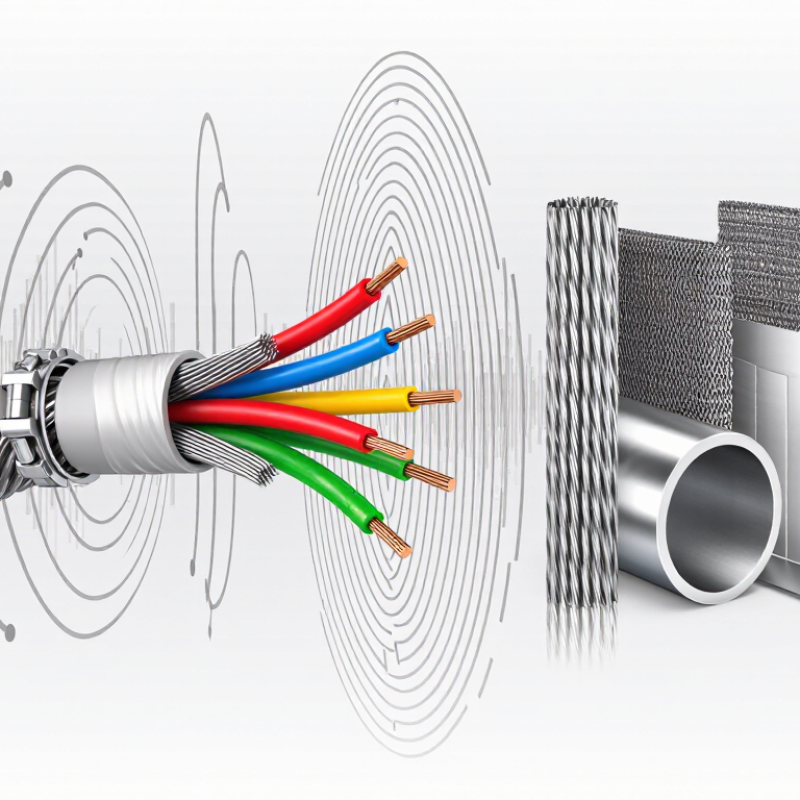
Table of Contents [Hide]
Definition and Basic Structure of a Wire Shielding Sleeve
What Is a Wire Shielding Sleeve and How Does It Work?
Definition and Basic Structure of a Wire Shielding Sleeve
A wire shielding sleeve is a flexible cover placed around cables or wire bundles. Its main purpose is reducing electromagnetic interference and radio-frequency noise. The sleeve commonly contains conductive metal fibers, foil, or a woven metallic layer. A textile outer layer may add abrasion and heat resistance.
Inside, the structure works like a controlled barrier. Interference reaches the conductive surface and travels along it toward a grounding point. It does not simply “block” every signal. Shielding performance depends on coverage, material conductivity, grounding, and installation quality. A loose braid can leave gaps near connectors. That detail is often underestimated.
Grand View Research estimated the global electromagnetic interference shielding market at approximately 6.5 billion US dollars in 2023. Its report also identifies electronics, automotive systems, and telecommunications as important demand areas. In practical cable assemblies, technicians usually check sleeve diameter, expansion range, operating temperature, and contact resistance. A sleeve that fits too tightly may damage insulation during movement. A sleeve that is too loose may provide uneven coverage.
Tips: Measure the largest cable bundle before selecting the sleeve. Keep the shield continuous across connectors when possible. Test the finished assembly under real vibration and temperature conditions. Laboratory results can differ from field performance.
What Is a Wire Shielding Sleeve and How Does It Work? - Definition and Basic Structure of a Wire Shielding Sleeve
| Data Dimension | Typical Specification or Option | Definition and Basic Structure | How It Works or Why It Matters |
|---|---|---|---|
| Product definition | Flexible conductive or metallized tube | A wire shielding sleeve is a tubular covering installed around one or more wires, cables, or cable bundles. | It creates a controlled barrier that can reduce electromagnetic interference, radio-frequency interference, abrasion, and accidental contact. |
| Primary shielding material | Tinned copper, bare copper, copper alloy, aluminum, or conductive fabric | The conductive layer may be a woven braid, knitted mesh, foil layer, or conductive textile construction. | Conductive materials provide a path for induced electrical noise to be redirected toward ground when the shield is correctly terminated. |
| Outer protective layer | Polyester, nylon, fiberglass, silicone, PVC, or heat-shrinkable polymer | Some sleeves include a nonconductive jacket or overbraid surrounding the shielding layer. | The outer layer may improve abrasion resistance, flexibility, temperature performance, chemical resistance, or electrical insulation. |
| Common construction | Braided, knitted, woven, foil-wrapped, or expandable | The construction determines how the sleeve expands, bends, overlaps, and conforms to the cable bundle. | A flexible construction allows installation over connectors and irregular shapes while maintaining broad surface coverage. |
| Shielding mechanism | Reflection, absorption, and diversion of unwanted electromagnetic energy | The conductive sleeve surrounds the cable and reduces the opening through which electromagnetic fields can couple to the conductors. | Shielding effectiveness depends on material conductivity, coverage, frequency, sleeve continuity, and grounding quality. |
| Electrical continuity | Continuous conductive path along the protected cable | Individual braid strands, mesh wires, or foil sections must maintain sufficient contact through the shielded length. | Gaps, poor overlaps, or damaged sections can reduce shielding performance and create leakage points. |
| Grounding and termination | Clamps, backshells, conductive glands, crimp rings, or conductive tape | The sleeve must be connected to an appropriate ground or chassis reference through a reliable termination method. | A shield that is not properly terminated may provide limited protection, even if the sleeve material is highly conductive. |
| Coverage type | Full coverage, partial coverage, or overlapping coverage | Full coverage surrounds the cable circumference; partial coverage leaves a defined opening or uses a braid with incomplete visual coverage. | Higher coverage generally supports better shielding continuity, while lower coverage can provide greater flexibility and easier installation. |
| Expandable diameter | Specified by minimum and maximum usable diameter | Expandable braided sleeves change diameter as they are compressed or stretched along their length. | Selecting the correct range helps prevent excessive looseness, difficult installation, or reduced coverage. |
| Frequency range | Low-frequency electrical noise through radio-frequency interference | Shielding behavior varies with the frequency of the interference and the physical dimensions of the cable system. | A sleeve should be evaluated at the frequencies relevant to the application rather than judged only by its material type. |
| Mechanical protection | Abrasion, flexing, vibration, and minor impact protection | The sleeve forms a protective layer around the cable without replacing the cable’s primary insulation or structural jacket. | It can help reduce wear caused by rubbing against nearby components, especially in moving or confined assemblies. |
| Thermal performance | Dependent on the specific metal, textile, polymer, and installation environment | Temperature capability is determined by the least heat-resistant component in the sleeve assembly. | The operating temperature, heat exposure duration, airflow, and proximity to hot surfaces should be considered during selection. |
| Typical applications | Automotive, industrial, telecommunications, consumer electronics, medical, and aerospace systems | Wire shielding sleeves are used wherever cable bundles require electromagnetic control, organized routing, or additional mechanical protection. | They help protect signal integrity, reduce interference between adjacent circuits, and improve cable-bundle durability when properly selected and installed. |





